
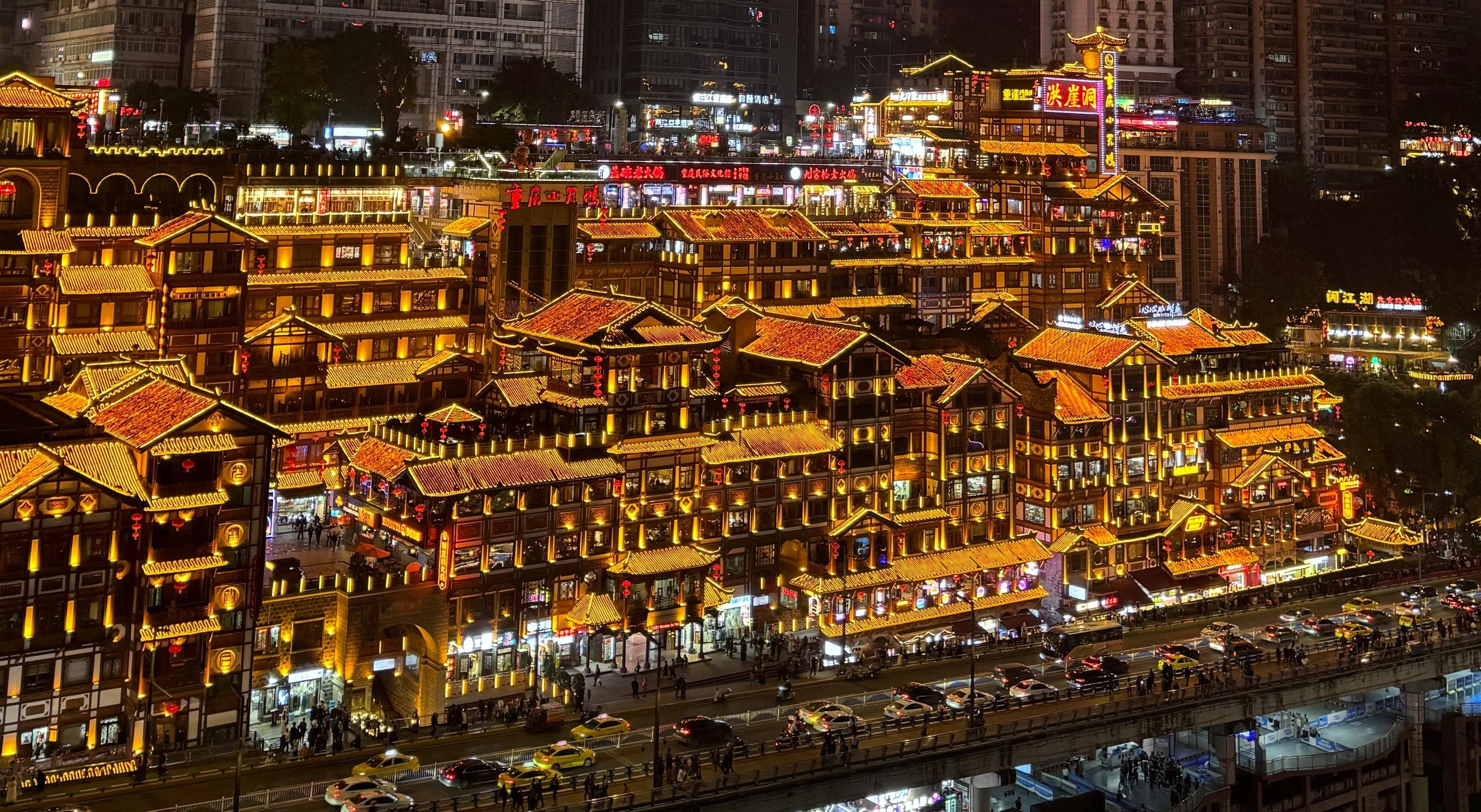
After decades of rapid development, many Chinese cities have exceeded mere modernity and entered the realms of futurism. Chongqing is, quite literally, a shining example.
With a population of over 30 million, Chongqing in southwest-central China is the world’s largest ‘city proper’. Hemmed in by the Yangtze and Jialing rivers, its centre is a dense mass of concrete and steel. Here, due to the city’s varied topography, town squares overlook vast urban canyons, and underground walkways descend to areas still many metres above the riverside.
The result is a multi-layered cityscape as dizzying to observe as it is disorienting to navigate.
A unique urban landscape
Perhaps Chongqing’s most famous – and quirkiest – attraction is Kuixinglou Square. Entered at street level, Kuixinglou is an impressive yet typical example of a plaza in a large Chinese city: spacious and surrounded by tall buildings, it’s a nice spot to stop and take photos.

Kuixinglou Square, central Chongqing.
It’s only when you approach the far end that it becomes evident Kuixinglou isn’t just any townsquare. It is, in fact, the roof of a 22-storey building…
Five stops from Kuixinglou on Chongqing Rail Transit Line 2 is Liziba Station, a metro stop spanning floors six to eight of a 19-storey block of flats. Opposite the station, crowds gather on the pavement to see monorail trains disappear into and emerge from the building as if passing through a mountain tunnel. With both ends of the train open to the public, passengers can even watch through the window as they approach and depart this futuristic stop.
Chongqing’s knack for overcoming spatial limitations is also apparent in its reuse of former air raid shelters. What protected the local populace from bombardment during the Second Sino-Japanese War now function as pedestrian walkways and even hotpot restaurants.
Chongqing after dark
After sunset, Chongqing’s multi-layered skyline comes alive with neon lights, and the city suddenly looks like the setting of Blade Runner. This is the ideal time to head to Qiansimen Bridge for incredible views of Hongyadong scenic area – a bustling tourist spot offering street food, hotpot, and its own impressive vistas.
An evening view of Hongyadong from Qiansimen Bridge.


Hongyadong at street level.
Inside the scenic area.

To see Chongqing’s skyline from another – equally spectacular – angle, cross Dongshuimen Bridge to Nan’an District.
Near Longmenhao Old Street – another scenic area worth visiting – is a location known for its hillside tea stalls, where visitors can enjoy tea and various edible accompaniments while taking in sweeping views of the city.

The Little Prince looks out over central Chongqing from Longmenhao Old Street.
Longmenhao Old Street viewed from Dongshuimen Changjiang Bridge.


The silhouette of a man – possibly Rick Deckard from Blade Runner – against the bright lights of Chongqing.
The Instagram-famous Xiangyunduan and other hillside chatan offer the perfect vantage point for watching the sun set over Chongqing – and enjoying the spectacular light show that follows.
Tea and snacks at Xiangyunduan Chatan.

Luohan Temple
With over three millennia of history, Chongqing isn’t all sparkling skyscrapers and modern engineering. The city and its surroundings are also home to several temples, and visitors needn’t travel far to reach what is possibly the most famous.
Right in the heart of Chongqing, surrounded by soaring office blocks, is Luohan Temple*. Originally constructed in the 11th century, the site today offers visitors a moment of calm in a city where serenity is hard to find.

Luohan Temple offers visitors to Chongqing a rare moment of zen.
The temple’s traditional courtyard set against a modern backdrop.

Luohan is the Chinese equivalent of the ancient Sanskrit word ‘arhat‘, which refers to a Buddhist who has reached enlightenment. The temple’s main hall houses over 500 life-size arhat statues, each completely different from the other.
Ambling through the narrow, twisting corridors of the arhat hall while admiring the sculptures’ distinct poses and facial expressions, it’s easy to forget you’re right in the centre of a sprawling, ‘cyberpunk’ metropolis.
*When I visited Luohan Temple, the entrance fee was CN¥20, equivalent to around £2.10 or €2.40 at the time of writing.

Share your thoughts: