
With vibrant, bustling metropolises like Bangkok, Kuala Lumpur, and Singapore, Southeast Asia is also home to some of the world’s most captivating smaller destinations. In this article, I rank my favourites so far…
Disclaimer: all of these destinations are brilliant in their own way, so don’t read too much into the (partly arbitrary) order. This list is based on personal experiences and biased towards the places I spent longest in.
8: Ayutthaya, central Thailand

Ayutthaya, around 80 kilometres north of Bangkok, is known for the Ayutthaya Historical Park. Featuring a multitude of ancient temples and monuments, this Unesco World Heritage site is like a more compact, urban version of Angkor Archaeological Park in Cambodia (high praise indeed).
While we only had enough time to visit the park on our day trip to Ayutthaya – which may explain why it doesn’t rank higher on my list – the city also boasts a floating market and a night market.
Even if you, like us, don’t manage to visit the other attractions, the park alone makes Ayutthaya a must-visit for anyone staying in the Thai capital for a few days or more.

Wat Phra Ram, one of Ayutthaya’s most famous temples.
A Buddha head in a tree on the site of Wat Mahatat.


A reclining Buddha statue at Wat Lokayasutha.
7: Huế City, central Vietnam

Huế is located at the latitudinal centre of Vietnam, making it a convenient stop on a north–south journey through the country. It’s also home to a Unesco World Heritage site, the 19th-century Huế Imperial City.
An impressive citadel featuring magnificent architecture and ornate gardens, the Imperial City ensures Huế is not just a practical port of call but a worthy addition in its own right to any Vietnam itinerary.
Also worth visiting are Đông Ba Market and, by all accounts, the Royal Tombs. The latter are situated a few kilometres outside the city centre – but we, sadly, didn’t have time to visit them.
Inside Thái Hòa Palace, Huế Imperial City.


Thái Hòa Palace exterior.
The Royal Theatre framed by rain-soaked rocks.

6: Chiang Mai and Chiang Rai,
northern Thailand

It may be controversial to cover northern Thailand’s Chiang Mai and Chiang Rai in a single entry, but the two cities are small enough, and sufficiently close to each other, to visit in the same short trip as part of a longer Thailand itinerary. That’s exactly how we experienced them, and my memories of the two places are so intertwined that I couldn’t possibly tell you which I prefer. Ultimately, it doesn’t matter. Despite their small size, the two Chiangs have so much to offer – with awe-inspiring temples, buzzing night markets, and plenty of other attractions to keep you busy however long you stay.
Must-sees in Chiang Mai include Wat Phra That Doi Suthep, a golden temple atop Doi Suthep mountain; Wat Pha Lat, a secluded temple tucked away in the dense forest part way up the same mountain; and Watchediluang Varaviharn, an ancient temple in the city centre.

Wat Phra That Doi Suthep atop Doi Suthep mountain, Chiang Mai.
Wat Pha Lat, hidden away in the jungle that covers Doi Suthep.

Visitors to Chiang Rai should take in the white and blue temples – Wat Rong Khun and Wat Rong Suea Ten – and Wat Huay Pla Kang, a complex overlooked by the goddess statue pictured above (which you can enter!). The Golden Triangle – where Thailand, Laos, and Myanmar converge at the confluence of the Mekong and Ruak rivers – is another interesting tourist spot. It’s around a two-hour drive from the city centre, with the views of the picturesque northern Thai countryside helping to pass the time.

The Golden Triangle near Chiang Rai, with Thailand in the foreground, Myanmar in the centre (left), and Laos in the background (right).
5: Ninh Bình, northern Vietnam

Considering we spent less than a day in Ninh Bình Province on an excursion from the Vietnamese capital, Hanoi, the place left a lasting impression on me.
Part of the Unesco World Heritage-designated Tràng An Landscape Complex in northern Vietnam’s Red River Delta region, Ninh Bình is home to the iconic Tam Cốc (‘three caves’). Here, tourists can take a rowing boat tour along Ngô Đồng River, between paddy fields and through the trio of caves from which the location derives its name.
Looming over Tam Cốc is Lying Dragon Mountain, which rewards a short but steep hike with spectacular views of the delta. The Hoa Lư Ancient Capital is another famous attraction, while tourists staying in Ninh Bình for longer than a day (how I envy you!) can take in the numerous temples and pagodas in the area.
A dragon statue atop Lying Dragon Mountain.


A view of the pagoda opposite the dragon.
Ngô Đồng River on the way to Tam Cốc.

4: Sa Pa, north-western Vietnam

Located in north-western Vietnam near the Chinese border, Sa Pa is a small town surrounded by mountains, valleys, and rice terraces and home to several local ethnic groups. While the town itself is a hive of tourist activity – with restaurants and coffee shops serving adventurers and digital nomads from all over – its stunning surroundings are the real attraction.
Sa Pa town functions as a convenient but charming base for the many trekking and hiking routes in the vicinity. We spent one night in the town centre and two nights in homestays in the bordering countryside, where we did plenty of walking – if not actual ‘trekking’. If you have enough time, it’s worth booking homestays along one of the trekking routes, reaching each one on foot before resting for the night and continuing your journey the next day.
Something to bear in mind is that Sa Pa, unlike most of Vietnam, has a temperate climate with four distinct seasons. Visiting in winter as part of a journey through Vietnam and on to the Philippines, we packed more for the year-round heat and humidity of the tropics than for Sa Pa’s cold, misty climes… and we suffered for it. Whatever the weather, Sa Pa warrants inclusion on any extended itinerary in this incredibly diverse country.

One of Sa Pa’s many rice terraces.
Morning coffee with a view.


Sa Pa town centre at night.
3: Siem Reap, north-western Cambodia

Siem Reap may be Cambodia’s second-largest city, but at around a quarter of a million inhabitants, it’s still small enough for inclusion in this post. It’s also a great destination in its own right, with a buzzing nightlife scene, some excellent restaurants, and the fascinating Old Market.
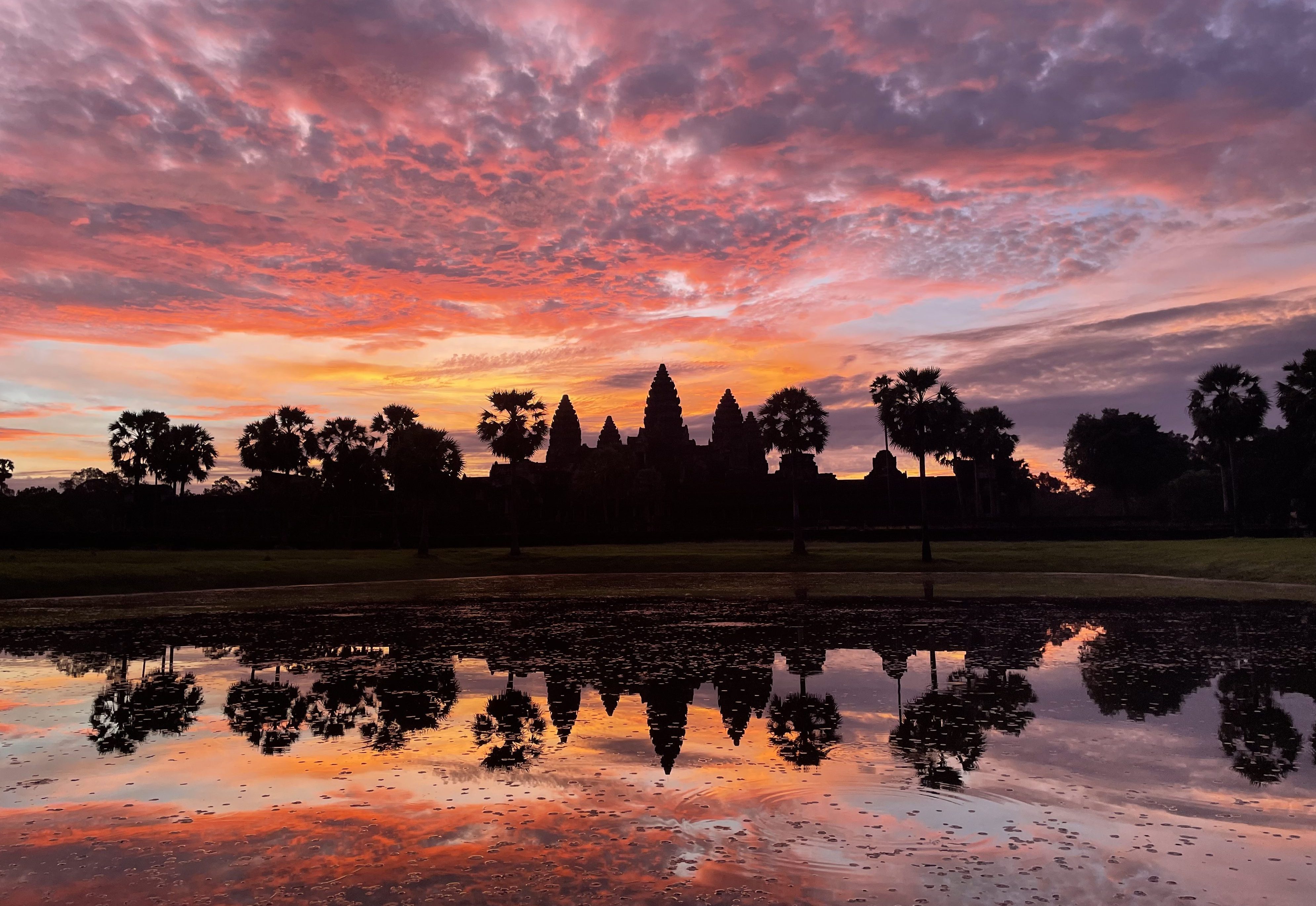
That said, it would be disingenuous to suggest Siem Reap owes its high position on this list to much more than its proximity to Angkor. The Unesco World Heritage site, once the capital of the Khmer Empire, is among the most impressive attractions I’ve visited. Angkor Wat is just one of numerous ancient temples dotted around an archaeological park spanning 400 km2.
Tickets, available on Angkor’s official website, allow one-, three-, or seven-day access to the park. Since we only had the weekend in Cambodia, we chose the one-day pass and – with the help of a taxi driver whose services we’d hired for the day in Siem Reap – rushed around the site from sunrise to sunset. It was sweaty work given the late-July heat and humidity, but even the feeling of my clothes clinging to my skin couldn’t dampen (excuse the pun) my enthusiasm for this awe-inspiring location.
If you have more time, I’d recommend the three-day pass, which provides better value for money and allows you to explore everything Angkor has to offer at a more leisurely pace. Archaeology or history buffs may be tempted by the seven-day pass, and I can easily imagine spending a week between Siem Reap and Angkor.
A young long-tailed macaque inside one of Angkor’s many temples.


Ta Phrom temple, where trees grow out of the ruins.
Singha look out over Angkor’s West Baray reservoir.

2: Hội An, central Vietnam

Hội An, Vietnam’s fourth entry on this list, is located roughly halfway between Hanoi and Ho Chi Minh City, just a few hours south of Huế by road. To say that Hội An, like Huế, makes an ideal stop on a longer Vietnam itinerary would not be inaccurate – but neither would it do justice to what is a singularly captivating destination.
In my opinion, Hội An alone is worth travelling to Vietnam for. I loved everywhere we visited in Vietnam – the locations featured in this post, the two metropolises mentioned above, and the iconic Hạ Long Bay – but our journey through the country peaked in Hội An.
Everywhere you look in this compact city, you find beauty. In the Unesco World Heritage-designated Ancient Town, houses, shops, cafés, and restaurants displaying indigenous, colonial French, and East Asian architectural influences are interspersed with Sino-Vietnamese temples and pagodas. The result is a multicoloured, multifaceted patchwork of buildings that reflects the city’s rich history and unique cultural identity.

The entrance to Chùa Pháp Bảo temple outside Hội An’s Ancient Town core, decorated for the Tết holiday.
An atmospheric backstreet in Hội An Ancient Town.

Hội An has plenty to offer outside the Ancient Town, too. Being a coastal settlement, it’s also popular for its beaches. On our final day in the city, we rented bikes and cycled through rice fields and small villages to reach An Bàng Beach, where we stopped for lunch.
Our cycle route also took us along the Thu Bồn River backwaters to the Cẩm Thanh Coconut Village, famous for its basket boats. While we decided against taking a basket boat tour, watching the unusually shaped vessels wend their way among palm groves as we cycled back towards the Ancient Town proved the perfect way to bring our time in Hội An to a close.

Basket boats waiting to be filled by tourists, Cẩm Thanh Coconut Village, Hội An.
Basket boats among the palm groves near Cẩm Thanh Coconut Village.

1: Luang Prabang, northern Laos

Nestled among forested hills in mountainous northern Laos, Luang Prabang lies on the banks of the Mekong and is intersected by the smaller Nam Khan River – a setting that lends the city a rugged yet cosy feel.
Although more laid-back and rustic, the Unesco World Heritage site is comparable to Hội An in its striking fusion of indigenous Southeast Asian and European architecture, with colonial villas turned hotels standing alongside Lao Buddhist temples.
This blend of East and West also manifests itself in Luang Prabang’s vibrant food scene: the cafés, pâtisseries, and boulangeries lining the main streets bring a distinctly local character to the culinary legacy left behind by the French. Unsurprisingly, restaurants serving traditional Lao fare – fragrant, spicy, and not dissimilar to Thai cuisine – can be found throughout the city.

Luang Prabang Night Market soon after opening, with Haw Phra Bang in the background.
Most activity in central Luang Prabang takes place on or around Sisavangvong Road. Home to many of the city’s most popular eateries, this lively thoroughfare hosts a night market selling local crafts and souvenirs and serving delicacies from Laos and beyond. It’s also home to the impressive Royal Palace & National Museum, part of a complex that includes the iconic Haw Phra Bang temple. Overlooking the street is Mount Phousi, a sacred, temple-topped hill offering panoramic views of the city and its environs.
A reclining Buddha statue part of the way up Mount Phousi.

Being surrounded by rivers and rainforest, Luang Prabang presents ample opportunity to explore the natural beauty of northern Laos. Tours are available from various agencies in the centre – or from guides waiting by the river, their boats ready to whisk you away along the Mekong at a moment’s notice. We opted to book ours at the hotel, paying around £75 for a day trip that took us to the mystical Pak Ou Caves, home to thousands of Buddha statues; the tranquil Manifa Elephant Camp, where we stopped for lunch in the presence of elephants; and the epic Kuang Si Falls. The tour was the highlight of our stay in Luang Prabang and an experience I highly recommend.

Just some of the thousands of Buddha statues in Pak Ou Caves.
An elephant freely roams Manifa Elephant Camp.


A shot of Kuang Si Falls taken through a misted lens.
Get in touch via the Contribute page for a free Southeast Asia itinerary! Simply provide some details about where you want to go and what you want to see, and I’ll be happy to help you plan your trip.

Share your thoughts: