
In part one of this three-part travelogue, my partner and I arrived in Bhutan with high expectations. In part two, we reach Thimphu, where we sample the local cuisine, have a close encounter with an unusual creature, and take in some truly impressive architecture.
Thimphu, capital of Bhutan
The short drive from Paro International Airport to Thimphu is predictably beautiful. On one side of the road is the Paro Chhu River; on the other are hills and the occasional shop, restaurant, or small settlement. Around a third of the way into our journey, we stopped at the Tachog Lhakhang monastery for our first experience of Bhutanese Buddhist culture.

Tachog Lhakhang monastery from across the river.
Tachog Lhakhang Old Bridge, which we crossed to reach the monastery.

Impressed by this small but charming monastery, we headed for our hotel, located just over the road from the beautiful Memorial Chhorten stupa in the centre of Thimphu, to drop off our luggage. Now unladen and with our stomachs rumbling, we were ready to try the local cuisine.

Memorial Chhorten, Thimphu.
Bhutanese cuisine: a curious combination of chilli and cheese
One of my favourite aspects of travel is sampling foreign foods. Normally, I’m familiar with a dish from restaurants at home or have come across it online or on TV, but I had no idea what to expect from Bhutanese fare. As it turns out, it can be summed up in two words: spicy and cheesy.
Unlike in most spice-loving countries – where chilli is used to add heat to sauces, for example – in Bhutan, it’s treated like a vegetable, consumed in much the same way as a portion of broccoli with an evening meal. Consequently, Bhutanese food is hot.
Perhaps to quell the burn, several dishes come doused in a cheesy sauce and accompanied by buttermilk, demonstrating a national fondness for dairy more typical of Europe than Asia. Meals are also served with red rice – a particularly healthy variety of the world’s most widely eaten grain.
Overall, the food was tasty and certainly unusual, which is something I appreciate.
Traditional Bhutanese fare, including (centre) the national dish, ema datshi – chillies in cheese sauce.

Takin it all in
Gastrointestinal tracts ablaze, we reconvened with the two Yeshis and got back on the road, this time bound for a nature reserve on the outskirts of Thimphu – and for a close encounter with Bhutan’s national animal: the takin.

Despite spending much of my childhood absorbed in books and documentaries about animals, I’d never heard of a takin – let alone seen one with my own eyes – so coming within inches of this bizarre, almost mythical-looking beast was an unexpected thrill.

Having taken in the takin, it was time to stop at the first major landmark on our tour: Great Buddha Dordenma – a huge golden Buddha statue that sits atop a hill overlooking Thimphu Valley.
This is, in fact, more than just a statue: Great Buddha Dordenma is mounted on a meditation hall housing thousands of smaller Buddhas in various shapes and sizes. Inside and out, it’s an awe-inspiring piece of architecture, and the site – aptly named ‘Buddha Point’ – provides stunning views over the valley.

Tashichho Dzong
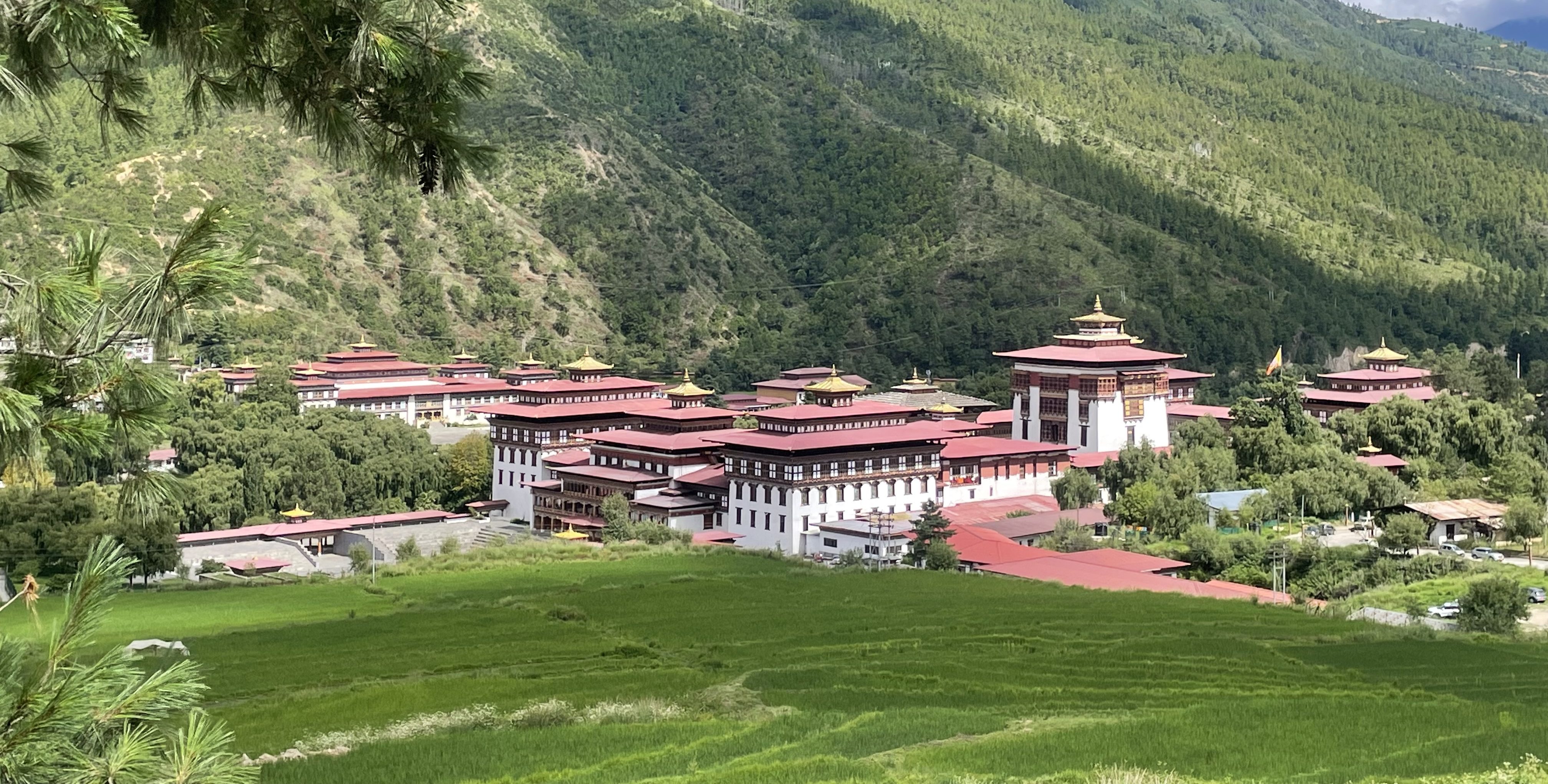
Next on our itinerary was Tashichho Dzong, a large Buddhist monastery and fortress that opens to the public at 5 pm.
Set within a garden, Tashichho Dzong comprises a complex of buildings surrounding a flagstone courtyard. From there, visitors can admire the architecture in almost total peace and quiet; aside from our tour guide, the only other people we saw there were monks.

Visiting Bhutan in the rainy season has its upsides, on reflection.
Compared with other monasteries we’d seen, Tashichho Dzong was far more imposing, and yet the façades were wonderfully intricate. Our visit had whetted our appetite for an even more iconic Bhutanese landmark – the enticingly named Tiger’s Nest Monastery.
On the topic of ‘appetite’, we dined that night at a pan-Asian restaurant in the compact but vibrant centre of Thimphu. The food – we ordered a mix of Chinese, Nepalese, and Bhutanese dishes – was delicious, while the local peach wine was a revelation.
After dinner, it was straight to bed: an early-morning hike to Tiger’s Nest awaited.
In the final instalment of this three-part travelogue, we reach Tiger’s Nest and bid a fond farewell to the Land of the Thunder Dragon.

Share your thoughts: