
In part two of this three-part travelogue, we arrived in Thimphu, where we sampled the local cuisine, had a close encounter with an unusual creature, and took in some truly impressive architecture. In the third and final instalment, we reach Tiger’s Nest and bid a fond farewell to the Land of the Thunder Dragon.
Reaching Tiger’s Nest:
a personal pilgrimage
After an early breakfast on the second and final full day of our tour, we left Thimphu to head back the way we came – towards Paro. Home to Bhutan’s only international airport, Paro is also where the country’s most famous landmark, the unmistakable Tiger’s Nest Monastery, is located.
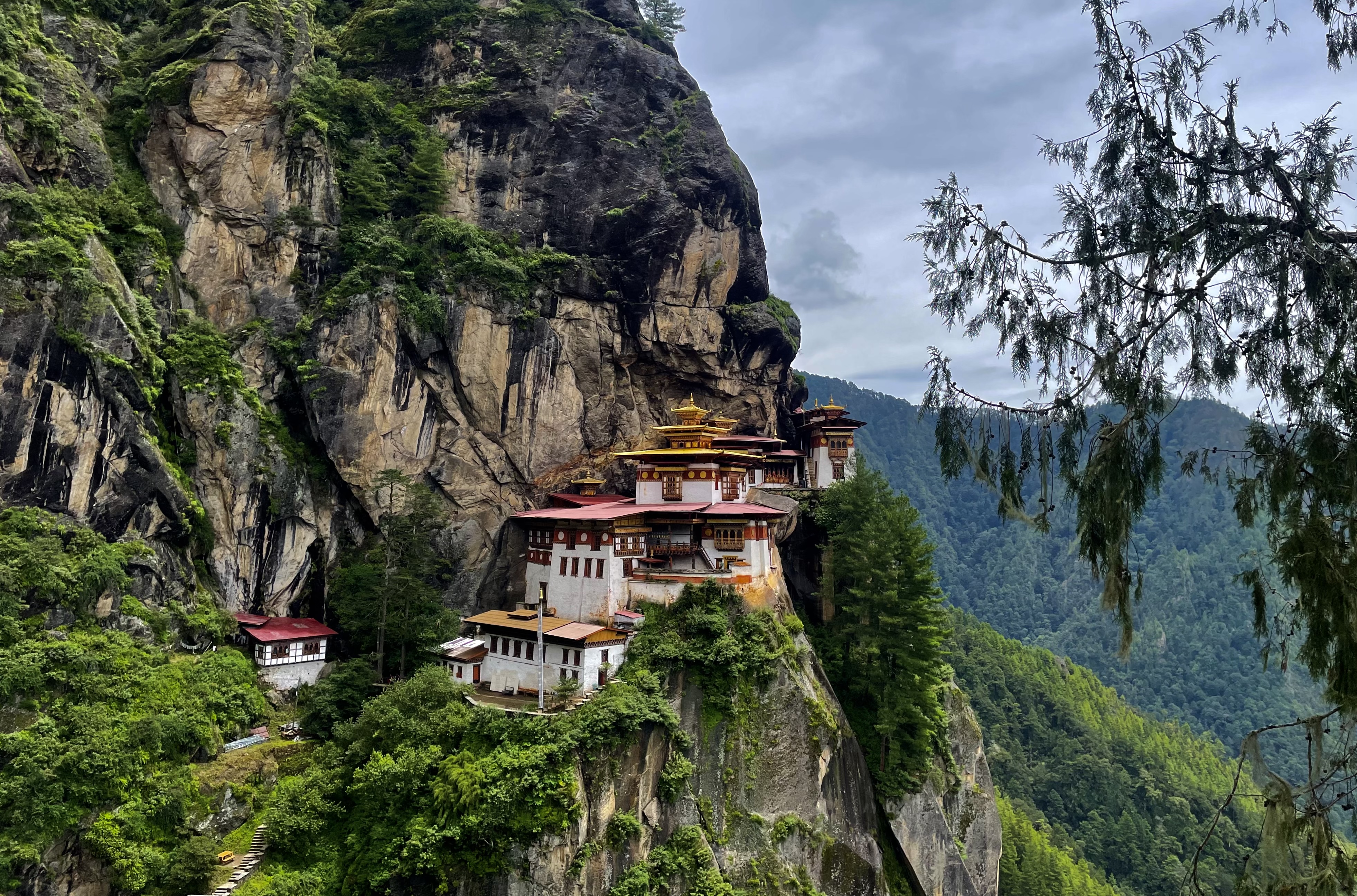
Known locally as ‘Paro Taktsang’, Tiger’s Nest is likely the first image to appear if you type ‘Bhutan’ into your search engine. It’s certainly one of the few clear images of the country I had in mind before visiting.
Reaching Paro Taktsang isn’t easy. It involves a steep hike to an altitude of over 3,000 metres, albeit with a more modest elevation gain of around 500 m from the starting point: a car park at the foot of the mountain. Yet the challenge only enriches the experience, making the way to the monastery feel like a pilgrimage even for non-Buddhists like us.
A hike like no other
As a bonus for those on short tours with no time for proper trekking, the hike provides an opportunity to experience Bhutanese nature. It follows a craggy, winding trail through a pine forest, with each opening in the treeline revealing a more impressive vista of Paro Valley than the last.
Along the way, several Buddhist shrines catch the eye – inviting you to stop and catch your breath – while prayer flags add an occasional splash of colour against the otherwise earthy backdrop of rock and conifers.
Tiger’s Nest is first visible from the foot of the mountain, but from there, it’s little more than a white speck on the distant grey cliff face – barely discernible as the sacred monastery that had enticed us to Bhutan.

Visitors who struggle with hiking can make the trip on horseback – although this particular equine was lacking a saddle.
It was around an hour into the steep climb that our efforts were rewarded. There, perched precariously over the precipice, was Paro Taktsang striking its famous pose.

Paro Taktsang/Tiger’s Nest Monastery.
We’d been to the Taj Mahal in India just eight days before arriving in Bhutan, and to Angkor Wat in Cambodia the previous year. Neither had impressed us quite as much as Tiger’s Nest.
Paro Taktsang owes a lot to its location; the building itself wouldn’t look nearly as spectacular in less dramatic surroundings. Then again, it would’ve been built differently on flat land. The monastery and its setting are so inextricably linked as to set the site apart from other iconic landmarks. The word unique is overused – but it undoubtedly applies here.
Inside the Tiger’s Nest
At that point, I’d have been happy to call it a day. Just seeing Tiger’s Nest up close was a dream come true. The possibility of entering the monastery hadn’t even occurred to me, and yet enter we did – after a gruelling climb up a long flight of stairs, that is. As if our legs hadn’t suffered enough…
Photography is prohibited inside the building, so you’ll have to take my word that the interior is – almost – as impressive as the exterior. The sense that this is a place of great cultural, historical, and spiritual significance is palpable. It can be seen in the shrines and artefacts, smelt in the incense that hangs heavy in the air, and heard in the murmured mantras of Buddhist monks.
I’m not religious, but the place had an energy that I struggled to put my finger on. Perhaps it was merely a combination of my excitement and the high altitude…
A fond farewell
While Tiger’s Nest was comfortably the highlight of our tour, it wasn’t the last item on our itinerary. Down from the mountain and now in the cosy centre of Paro, we had a local lunch of buckwheat pancakes and butter tea before visiting Rinpung Dzong – a majestic building in its own right.
The inner courtyard of Rinpung Dzong, Paro.


A view of Rinpung Dzong from a bridge spanning Paro Chhu.
That evening, our last in Bhutan, we explored the labyrinthine grounds of our luxurious riverside hotel and later ordered room service.
We woke up early the next morning to catch our flight back to Kathmandu. Before entering the airport, we bade a fond farewell to our guide, Yeshi Wangdi; to our driver, Yeshi Wangchuk; and to the Land of the Thunder Dragon itself, where we’d spent two unforgettable days.
Returning to Kathmandu.

So, was it worth the money? By now, you probably know my answer… I look forward to returning one day – and when I do, it’ll definitely be for longer than 48 hours.
If you’re interested in taking a tour of Bhutan – whether for 48 hours or longer – I highly recommend Third Rock Adventures. Beyond the quality of the tour itself, the customer service is exceptional. Naba, the company’s founder and director, embodies the warmth and hospitality of his homeland of Nepal, and we enjoyed meeting up with him in Kathmandu after returning from Bhutan.
Share your thoughts: