
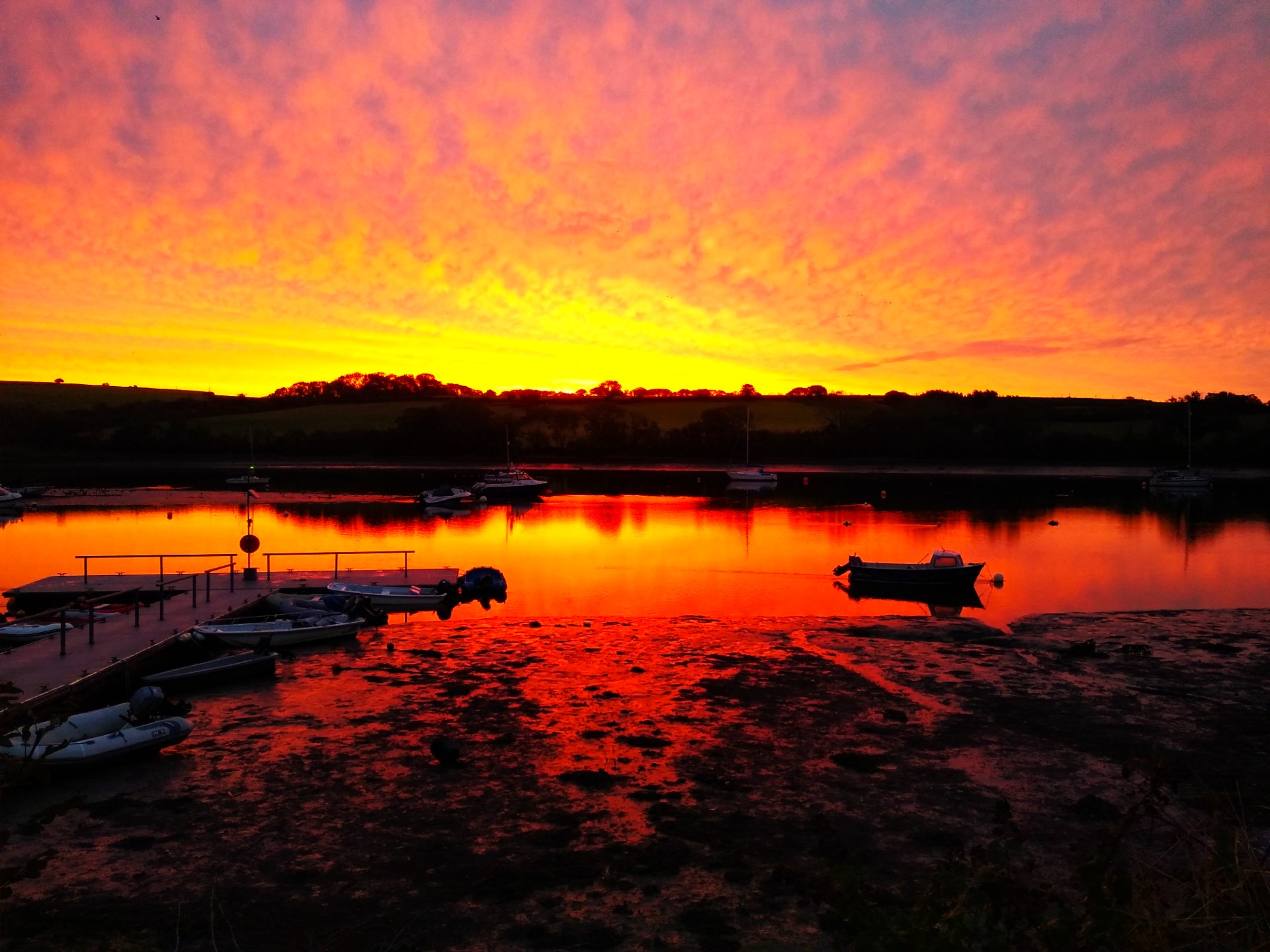
In The Travel Tome’s first contributed piece, award-winning Wales-based poet Diana Sanders leads the reader through a reverie brought to life by nature’s chorus in Aberteifi (Cardigan), West Wales.
Aberteifi Sonata
Just before dawn rises over the Teifi estuary, water is the colour of hips of the burnet rose (Rosa spinosissima) – black, shiny, reflective. The deep sleep of night is almost over. Light from distant stars and a crescent moon, thin as silver wire, dims as our own sun holds sway. Oak trees that line the bank fidget with waking crows. As black shifts to the colour of a rich merlot, they stretch their wings, wheel and dive, then settle again on anchored boats like a series of quavers on a music score. As the sky flares to blood orange, the music changes tempo and volume as the crows fill the sky with notes – a cacophony of rattles, caws, croaks. It is a crow sonata with wingbeats of passing swans, the shrill staccato of oyster catchers, and the warbles of curlews. Accompaniment is provided by the soft, constant movement of water as the tide rises, and the percussion of halyards clanking in the wind. The sound is of this moment, preserved in memory like insects in amber. It is a unique acoustic signature that changes subtly from minute to minute, from season to season, and from year to year.

This summer, the voices of the streams that feed the estuary have been subdued and delicate, like the call of a goldcrest. In contrast, throughout the previous winter, the sound of the water was charged and rampant. When the rain lashed in from the Irish Sea in horizontal drifts, the noise of water was everywhere. It seeped from the fields, dripped onto sunken lanes, and tore along gutters. Rills appeared where there were none before. Streams roared and drummed like a deranged musician.
As I walk along the estuary to the sea cliffs that look out to Ynys Aberteifi (Cardigan Island), the wind at St Tudwal’s Lighthouse moans its welcome to the morning. I am captivated by the sight and sound of waves rhythmically bombarding the shore. Sometimes, when a wave crashes into a sea cave and compresses the trapped air, it gives rise to an explosive boom. And in contrast, if you put your ear to a rock, you can hear the quiet creaking of barnacles as they wriggle in their tiny shells.
Between September and November, Atlantic grey seals (Halichoerus grypus) give birth in sheltered coves. Their pups’ mews and moans sound uncannily like the cries of human babies. No wonder so much literature and music has been written about seals and their songs. For example, Marjory Kennedy-Fraser and Granville Bantock wrote the Celtic folk opera Seal Woman in 1924, based on the selkie legend. Selkie is the Scots Gaelic word for ‘seal’. In mythology, selkie are shape-shifters, shedding their seal skin to become human for a while. If their skin is lost or stolen, they become trapped on land, never able to return to their true home. Many are familiar with the land song of the seal, but most of their vocalisations are under water. I imagine diving with them into an ocean of blue silk with air bubbles like jewels on my skin. I listen to their barks, moans, and roars.

Perhaps, if I swam further out, I would hear the chorus of bass rumbles, overtones, tail-slaps, and clicks of a distant whale. Maybe I would hear wreck-chatter from the many sunken vessels that litter this part of the coast.
I surface from my daydream and focus on the horizon, where the joining of sea and sky blurs, as if at this meeting point their identities merge. This is a profound and beautiful reflection of the interconnectedness between us and everything we can perceive in our environment. The real wonder is that everything on this planet is born out of stars, and we are only brief custodians of our atoms. People can do extraordinary things with this opportunity, bringing positive change to the world around them. For instance, some marine biologists play the sounds of a healthy coral reef through underwater speakers to encourage sea creatures back to damaged reefs that are being slowly regrown by human replanting. This has been successful in various reef systems including those around the US Virgin Islands. Returning creatures include rays, parrotfish, whitetip sharks, reef octopus, and barracuda. The recorded sounds are gradually replaced by real pops, howls, chirps, grunts, whistles, snaps, bumps, buzzes, squeals, heartbeats, teeth-gnashing, gill-flapping, and staccato clicks.

Each era of history has a unique sound signature. As I write this on the 22nd of September 2025, as well as the sound of water, birds, and boats, I can hear the rumble of road traffic and an aeroplane overhead. The first car was driven on a road by Karl Benz in 1886, and in 1804, Richard Trevithick invented the first railway steam engine. Before this, the sounds of humanity in this area would have been very different. There would have been the snort of horses, the grind of cart wheels on tracks and cobbles, the clang of hammer on anvil, and the hiss and release of steam. In the early 1800s, activity around the estuary would have created a dissonance of whirring wheels, hammering, clanking, the roar of machines and men shouting from the timber yards, saw mills, shipbuilding, tanneries, brick works, lime kilns, and rope makers.
Much further back, in the Iron Age, the sound of horses and the blacksmith would also have been familiar alongside the sound of pigs, sheep, and cattle. Music would probably have been as important in Iron Age Wales as it is now. And while there is no doubt that drums would have been commonly heard, hardly any have survived. Archaeologists, though, have discovered fine examples of the carnyx and the lyre. The carnyx is a wind instrument made of bronze, standing about 1.8 metres tall. It was played vertically and had a straight tube that flared out to a bell shape, worked into the form of an animal. One example was formed into the shape of a snarling boar. The deeply resonant trumpet-like sound would have been audible over large distances through forests, over moorland, and reaching the small islands out to sea. Perhaps it would have sent shivers down the spines of enemies when used in battle – or a buzz of excitement through a crowd when played at a festival.
Each sound heard on our planet is unique. Voices join to create so much more than a song or a sonata. They create a symphony – each creature, plant, and natural phenomenon playing its part. But sometimes, there is an unnatural quiet pause when you would have expected a beautiful phrase. Something has been lost; a voice forgotten, a creature extinct.
What is extraordinary to me is that it is possible for us to hear sounds of other planets through the medium of radio waves. Mercury, Venus, Mars, Jupiter, Saturn, Uranus, and Neptune all have their own unique sounds. Our universe, too, is full of its own acoustic signature.

At the end of this day, the 2025 autumn equinox, I stand again at the estuary’s edge. A murmuration of starlings appears like a spectre over the hills. I hear the whoosh of wings and their whistles, clicks, warbles, and purrs. Sometimes their voices are in unison, and sometimes they call with interconnected phrases. Starlings, along with other birds, have a voice organ called a syrinx. This consists of membranes that vibrate to create sound. ‘Syrinx’ comes from a Greek word meaning tube or duct. The term was later used to refer to a musical instrument consisting of a series of hollow reeds of varying lengths, each producing a different note when blown across. This instrument is closely associated with the Greek god Pan, who is often depicted playing the syrinx. Starlings have more muscles in their syrinx than other songbirds, giving them the ability to sing more complex songs. They use their tongue and beak to articulate the sound and can blend different sounds together into songs that last up to two minutes. As with human singers, they use controlled breath to support the sound. Individual birds have signature songs, but the community also have shared phrases and melodies.

Starlings at sunset.
As the sun falls over the horizon, the starlings’ anthem softens to a whisper. They descend from the sky to roost in reed beds that ripple and shiver until the music of the day dips into silence.
Learn more about the author, Diana Sanders, on our Contributors page. If you’re feeling inspired or have a story to share, submit a contribution proposal here.

Share your thoughts: