
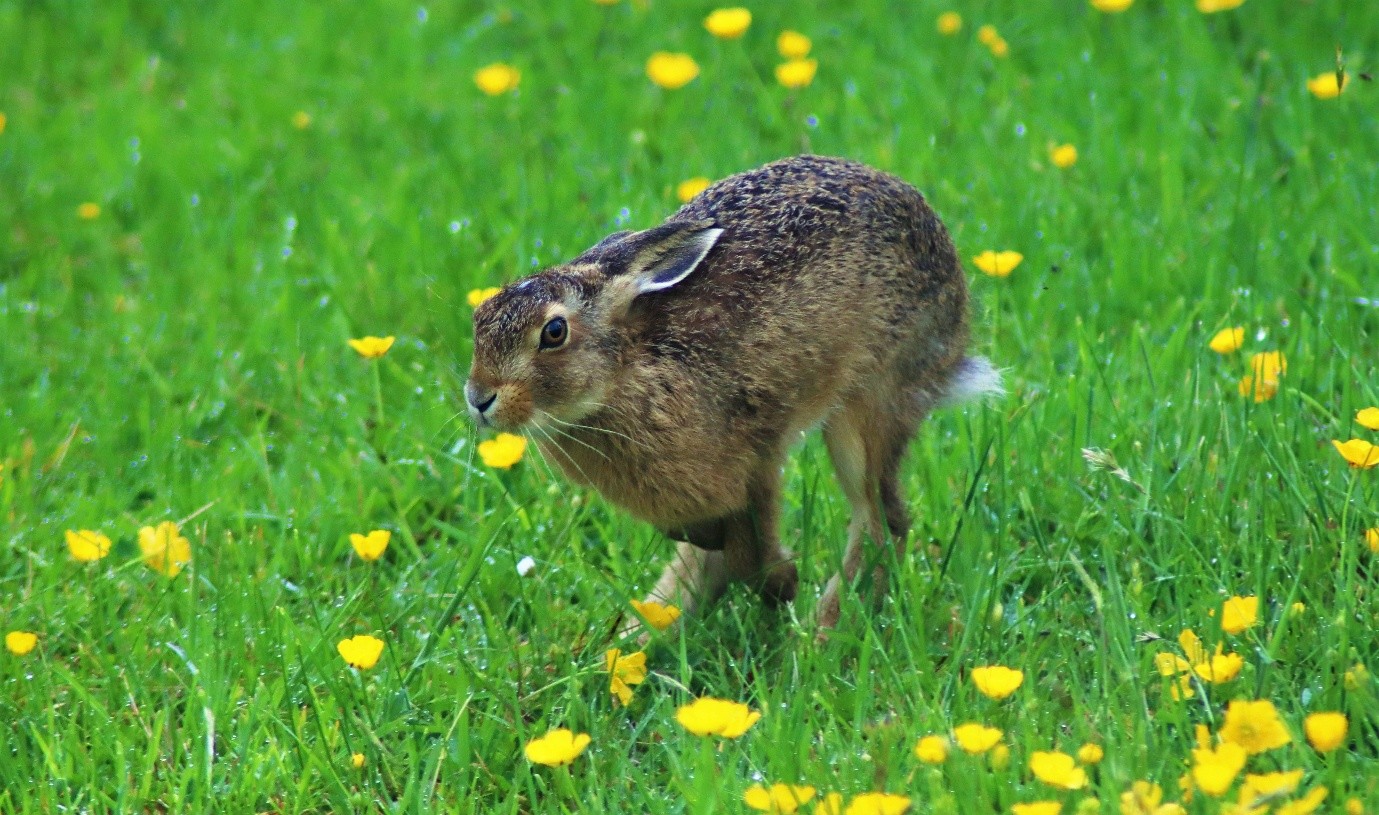
In her second contribution to The Travel Tome, Diana Sanders (Aberteifi Sonata) weaves in local history and original poetry as she recounts her meeting with a brown hare near the village of Llanfihangel Glyn Myfyr, North Wales.
A poet’s meeting with a brown hare in Llanfihangel Glyn Myfyr
A brown hare slips under the fence leaving green streaks in cobwebbed grass. She comes with the dawn in a tangle of smoking breath, boxing with birch shadows, a russet and black apparition whose eyes glitter and flame.
She is the frisky-one, the dew-hopper, the furze-cat, the snuffler, the swift-as-wind, the light-foot, the way-beater, the sitter-in-bracken, the shapeshifter, the boxer, the witch-hare. She was sacred to Celts and Anglo-Saxons, pet to the goddess Eostre, bringer of fertility and new life.

The brown hare resting on a rock.
She has come into the garden of a 17th century cottage, just outside the village of Llanfihangel Glyn Myfyr. This small village, in the valley of the river Alwen in North West Wales, was the inspiration behind William Wordsworth’s poem Vale of Meditation. It lies 350 metres above sea level, on the edge of the Hiraethog Moors. Apart from hares, it is the home of many other animals such as otters, dippers, foxes, stoats, weasels, raptors, songbirds, and the occasional shy woodcock. It is a landscape of streams, glacial lakes, and reservoirs – a land overflowing with history. Old farmhouses lie in the bottom of reservoirs, drowned to provide water for people of the Wirral. Old roads can be seen disappearing into the water. Medieval sheep enclosures make rectangular patterns in the grass and Bronze Age mounds crown hilltops. The weather can be wild, with winds that shake buildings and bring down trees. Horizontal rain leaves sheep hunched and people miserable, but there is something about this valley that gets under your skin and gives meaning to the word hiraeth, which describes longing for something that has passed.
In the woods above Llanfihangel Glyn Myfyr, there is an inscribed stone dating from the seventeenth century that used to guide pilgrims across the moors. According to the historian Suriyah Evens, it is the only surviving stone of the many that used to guide travellers. This particular stone directed people to a nearby farm called Hendre Glan Alwen, which provided bed, supper, and breakfast. The stone is inscribed with the date 1630 and the letters ‘HR’ – the initials of Hugh Reynallt, who rented the farm.
The guide stone in the woods above Llanfihangel Glyn Myfyr.

Llyn Brenig
Wind
ruffles water.
Waves curl and swarm
into a walk-on-water heron
which trembles into wood smoke
and a girl skimming stones across
the river. River, hidden under the lake.
Full of memories, dreams and windows.
Bryn Hir, farmhouse, where wood is popping
in the hearth and flames warm chilled fingers.
Winter holds fast and the shepherd curls into his
sheep’s wool bed. He dreams of waves
breaking in through thatch and door.
The land is sighing out an ache.
Hiraeth, home lost to flood,
valley lane, moss soft.
Tarmac rippled.
Falling into
water.
The April full moon is the Hare Moon, and it is April when hares come from the surrounding sheep fields into the garden of the old cottage. They come for the daisies, herbs, carrot tops, and other shoots. The brown hare, unlike the rabbit, makes no burrow or permanent home. They are nocturnal wanderers covering several kilometres per night. During the day, they lie in a ‘form’ or ‘scrape’ (a bed of flattened grass surrounded by vegetation) to be spotted only by the keen sighted, as their brown fur, with tints of red and gold, gives perfect camouflage. Hares are thought to have been brought here by the Romans but are now naturalised and have populations throughout Britain. According to the Hare Preservation Trust, in the late 1800s, there were about four million hares in Britain. Recent surveys show that the brown hare population has declined by 80% over the past 100 years. The reasons for this are possibly the intensification of agriculture, the loss of wildflower meadows, and shooting.
On a particular morning in April, I saw a hare in a scrape behind the shippon that used to house cows. It was enjoying the sun-warmed stone on one side and a strategic view of the valley on the other, its black-tipped ears resting flat on its back. I looked for a few moments and then tip-toed away.
Sight
The sun is an old coin
falling into peat.
An aureole sneaks
around hare’s ears.
She lowers them
and folds into grass
but lifts her nose
to the quiet light.
The farmer turns
his gun away.
His eyes burn
with afterimages of gold.

Hares lie still in the face of danger until there is no choice but to run. In such circumstances, they spring out and can outrun any other wild mammal in Britain. They are top athletes with large hearts and specialised bones in their noses that allow more oxygen for their sprints.
Wind
After Ted Hughes
The moon shudders and folds inwards,
dissolving into an untamed sky.
Clouds are shadow puppets that rear and buck
and I am like the swallow, shaken
and raw, diving into holes of wind.
A refuge away from the flight
of shrieking tree boughs and debris.
A quiet place in this topsy-turvy rumble
but even the eaves tremble as the wind bites.
This house has been far out at sea all night.
The noise of the night has silenced the frogs;
quiet now under crusts of water. They wait
for beams of light to burn holes in the cold.
Only then will they resume their singing.
Inside I listen to the deranged musician
who pounds the roof with fiendish hammering.
He is the drummer, the horn blower.
Calling the revenants. They swarm in the wood,
march nearer. I cry at the hurtling:
The wood crashing through darkness, the booming.
The storm brings flashes of light.
Ravens harassing birth-bloody lambs.
Their eyes sparking forks and black beaks delving.
Craven thieves stealing sight from the newborn.
There is no mercy; just throats that gobble.
Out of sight, a hare lies under a scarecrow,
playing dead under the swaying straw man.
If he ran, they could not catch him. He is
faster than flying geese and the raging
winds stampeding the fields under the window.
The rain pounds. Glass is a river, grass
is a river. Wind and water are all there is.
I shut the curtains and push back the night,
turning inward like a dormouse. Warmth spreads
outwards from orange-gold hazel. Hands
and feet, a flickering yellow duet.
Light turns out shadow, flashing on stone
and through stone, like a daffodil growing
out of rock. A stalwart beauty and yet
floundering black astride and blinding wet.
Female hares box. They rise on their hind legs to fight off unwanted male attention. When they give birth, they find a quiet place, usually in long grass where the young can remain undisturbed. Leverets are born with eyes open and soft, fluffy fur. They are odourless, which is necessary as the mother leaves them as soon as they are born, returning only once a night (for the first month or two of their lives) to feed them. They can have three or four litters a year.
Birth
A trespasser slips under the fence
leaving streaks of green in dew-cobwebbed
grass. She comes with the dawn in a tangle
of smoking breath, shadow-boxing
with birch shadows. A russet and black
apparition whose eyes glitter and flame
with Betelgeuse. New life knocks at her belly,
impatient for the taste of fresh grass. I watch
her from the window, as she races the merlin
over the meadow, leaving two bleary-eyed
leverets under the rosemary bush.
Later, on that morning in April, the female hare had shifted to the front garden. She moved from plant to plant, sniffing and tasting until she settled by a large rosemary bush near the kitchen door. She sat under it and scraped away at the earth. When she had finished, she moved off into the adjoining sheep field. That evening, she sprinted by me as our paths crossed near the house. Opening the curtains the next morning, I saw her two newborn leverets sitting still as stones near the kitchen door.

The experience of watching hares is almost sacred – a gift that lifts you out of the mundane world. Separateness falls away, and you become part of something finer, deeper. To imagine the world of the hare is to have all senses heightened. Colours are brighter, sounds sharper. You can hear a vole rustle in the next field – know the secret places where the fox does not go. Drink from gold-mirror pools, lit by the dawn sun. On moonless nights, you find your way by the stars and, on pitch-black nights, trust remembered paths to guide you across the untamed moor.
Photos, poetry, and text by Diana Sanders. First published in Natur Cymru in summer 2023.

Share your thoughts: