
In the first instalment of this two-part travelogue, I arrive in The Gambia, meet some monkeys, and visit an authentic Gambian market.
The Gambia
When I travel with my partner, we dedicate entire evenings to mapping out routes, finding the best connections, and looking for the best-value accommodation. My dad tends to take a more ‘traditional’ approach to planning trips – i.e. he leaves it all in the hands of a travel agent.
It was during a visit to his favourite travel agency to book another holiday that a brochure caught his eye: The Gambia and Senegal. For him, sub-Saharan mainland Africa was uncharted territory. After perusing the brochure for a while, he decided that his next big trip, in February 2024, would be to West Africa.
Since I, like my dad, had never ventured south of the Sahara on the African mainland (we’d been to North Africa and the island of Cape Verde), I didn’t need much convincing to join him.
Pre-departure considerations…
Mosquitoes can be an issue in sub-Saharan Africa. After a consultation with a travel health specialist, we paid £70 for the yellow fever vaccine and accompanying certificate. We’d read that the certificate was a requirement for crossing the Gambia–Senegal border, but we were never asked to show ours at border control…
Ah well, better safe than sorry – and besides, vaccination against yellow fever lasts a lifetime and is highly recommended for travel to many African and South American countries.
Malaria is the other mosquito-borne disease you’re advised to protect yourself against when visiting The Gambia and Senegal. Rather than a vaccine, anti-malarial medication comes in the form of pills, which we took once daily from the day before our trip until a week after our return. Prices vary, but they were considerably cheaper than the yellow fever vaccine…
Arriving in Banjul, capital of The Gambia
For The Gambia, booking our holiday with a travel agent made sense as scheduled direct flights to the country aren’t (at the time of writing) available from the United Kingdom.
We flew on a charter flight from Manchester directly to Banjul, the Gambian capital – a journey that took around six hours.
On arrival at Banjul International Airport, we had to pay an entry fee of $20, which can also be paid in pounds, euros, or the local currency, dalasi. Visitors should bear in mind that the same sum has to be paid as an exit fee on departure…
With our wallets the equivalent of $20 lighter, we left the airport and boarded the coach that the travel agency had arranged for us.
The drive from the airport to our hotel in the touristy heart of Serrekunda gave us an interesting glimpse of local life. Despite the time, the sandy streets were abuzz with activity and colour. We passed a square where a large group were watching Ivory Coast versus DR Congo in the African Cup of Nations on a big screen. Football is huge in this part of the world.
After around 40 minutes, we arrived at our accommodation – a stylish, modern hotel with a palm tree-shaded pool at its centre.
The sights and sounds of Serrekunda
The next day, I awoke to the sound of birdsong – but not a type I was familiar with. The Gambia, like Senegal, is a birdwatcher’s paradise. While I’m no ornithologist, I was fascinated by the variety of birdlife. I saw tiny, colourful bee-eaters; long-tailed starlings with vivid plumage; and fearsome-looking hooded vultures – and that was before we’d left the hotel.
As impressive as the birds were, we knew there was plenty more wildlife to see, so, after breakfast, we headed to Bijilo National Park – otherwise known as ‘Bijilo Monkey Park’ – a 51-hectare nature reserve sandwiched between Senegambia Highway and the Atlantic coast.

A group of goats braving the midday sun on Bertil Harding Highway, Serrekunda.
Densely forested, Bijilo Monkey Park provides a window into the area’s past – before the rest of the jungle was cleared for resorts, hotels, and restaurants. It’s still home to a range of fauna, and as the name suggests, monkeys are the main attraction, with the two most common species here being the green vervet and red colobus.
In addition to the modest entrance fee, we’d paid for a guided tour, which we’d haggled down from the original – no doubt inflated – quote to a more palatable price. We’d also bought a bag of monkey nuts, making us popular with the red colobus, who have a penchant for peanuts, but less so among the banana-loving green vervets.
A red colobus happily taking monkey nuts straight from my hand.


A pair of green vervets sitting on a termite mound looking decidedly less interested in our offer of peanuts.
A short walk from Bijilo National Park towards our hotel lies Senegambia Road, Serrekunda’s main tourist strip.
Here, immediately outside the resorts and hotels, it’s common for visitors to be approached by pushy taxi drivers, street vendors, tour guides, and young men the locals referred to as ‘bumsters’. The latter, likely driven by desperation, often hassle or attempt to befriend tourists for money.
In our experience, these encounters were mostly good natured. While they could be mildly annoying at times, they never felt threatening. Besides, The Gambia is one of the poorest countries in the world, so attempts by locals to profit from tourism are understandable.
Arriving at Senegambia Road, we saw that it was teeming with European holidaymakers and had all the hallmarks of a package tour destination, with bars and restaurants serving cheap booze and English breakfasts.
Senegambia Road, with a sign displaying happy hour drinks offers in the foreground.

We hadn’t travelled all that way for bacon and eggs, so we were pleased to find most of the restaurants served local dishes, too. I ate a flavoursome chicken stew with filling fufu (pounded yam dumplings), washed down with a teeth-achingly sweet malt drink – a great first impression of West African cuisine.
Authentic Africa
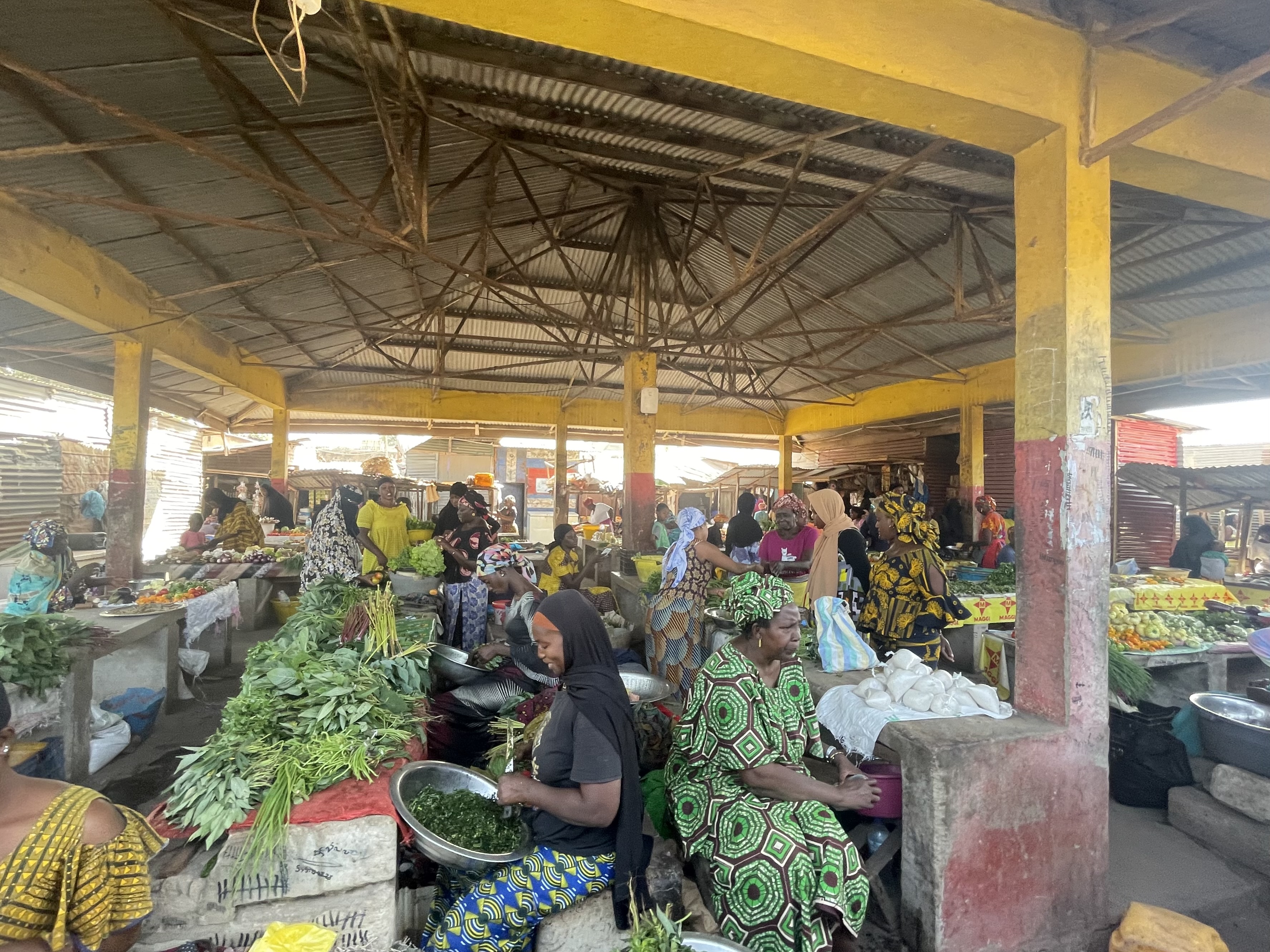
Seeking a more authentic representation of local culture on our second full day in The Gambia, we headed inland, away from the more tourist-oriented parts of town, to Sanchaba Market.

A sun-drenched residential road leading towards Sanchaba Market from Bertil Harding Highway.
Although it wasn’t an especially long walk to the market from Senegambia Road, where we’d returned for lunch that day, it was tough going in the blazing subtropical sun. Even in early February, the temperature was approaching 40 ⁰C.
It was worth the effort, though. The way to Sanchaba Market revealed a quieter side to Serrekunda. There were no bumsters and very few tourists – just locals of all age groups calmly going about their day.
The market itself was less tranquil. It was, in the best possible way, a hive of activity – alive with colour, commerce, and conversation. This was the authentic Africa we’d come to see.

Now weary from sun exposure, we shuffled back to our hotel via the only shopping centre in the area, Tropic.
An air-conditioned oasis offering welcome shelter from the heat, Tropic Shopping Centre also provides varied dining options including a delightful coffee shop, L&P Sweets.

With nothing special planned on our third and final day in The Gambia, we divided our time between the Atlantic coast beach, the hotel pool, and the local restaurants – just what the doctor had ordered ahead of our long journey to Senegal the next day.
In the second instalment of this two-part travelogue, I cross the Gambia River by ferry to reach Senegal, where a stunning riverside resort and a first safari experience await.

Share your thoughts: