
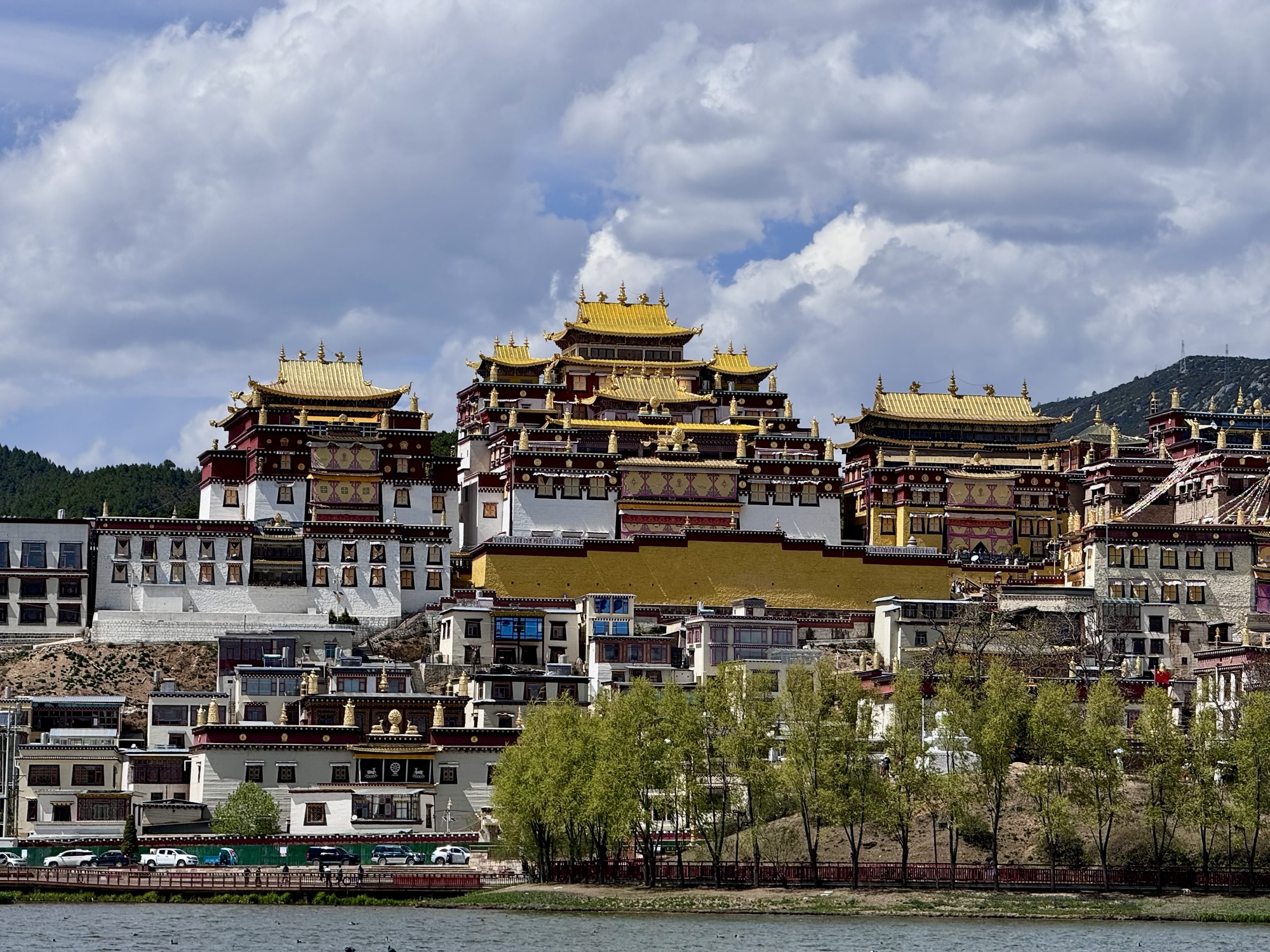
Named after the fictional setting of James Hilton’s Lost Horizon, Shangri-La City is a culturally Tibetan gem nestled in the Hengduan Mountains in China’s Yunnan Province.
Tibet is high on my travel bucket list. Unfortunately, visiting the region requires a travel permit and pre-arranged guided tour, so it’s not a place you can just nip over to on a whim. For anyone exploring China, the country’s Tibetan Autonomous Prefectures offer a cheaper and more convenient way to experience Tibetan culture.
The only such prefecture in Yunnan Province, Diqing has become a popular destination thanks to its enchanting capital city, Shangri-La. Referred to as ‘Gyalthang’ among the local Tibetan population, Shangri-La was renamed in 2001 to evoke the setting of the James Hilton classic Lost Horizon, as part of a tourism drive by the Chinese government.

The small city certainly has the mystique, isolated setting, and – at over 3,100 metres above sea level – altitude to draw comparisons with its fictional namesake, but it isn’t quite how I pictured Hilton’s Shangri-La. Regardless, it’s a gem of a destination that anyone travelling to Yunnan or Sichuan Province should take the opportunity to visit. We flew there from Chengdu while living in the Sichuanese capital.
Dukezong Ancient Town: Shangri-La’s historical centre
Dukezong Ancient Town, Shangri-La City’s main hub of tourist activity, boasts well over a millennium of history. Despite almost two-thirds of it being lost to a fire in 2014 (Google Maps still shows the damage), the town retains much of its historical charm, with the wooden buildings painstakingly restored in their original style.
While Dukezong is undeniably touristy, it has a distinct Tibetan feel that sets it apart from other popular locations in Yunnan, like the nearby Lijiang (a great destination in its own right). You’ll still find some of the chain establishments characteristic of a typical Chinese ‘scenic area’, but these stand alongside authentic teahouses, Tibetan restaurants, Buddhist stupas, and shops selling local goods and crafts. Even the accommodation offer leans towards the traditional.

A typical street in Dukezong Ancient Town, Shangri-La City.
Dukezong’s North Gate at night.


A dog rests in the shade opposite a stupa in Dukezong.
We stayed at a homestay run by a Tibetan family, who treated us to a delicious breakfast of local bread with melted cheese and a spicy condiment, all washed down with yak butter tea. The latter is an acquired taste that I was pleased to find I had acquired since first trying it in Bhutan, where I was unable to finish the cup. Here, on my second attempt, I finished the whole pot.
A traditional Tibetan breakfast consisting of bread and melted cheese with yak butter tea.

At the heart of Dukezong is Guishan (Turtle Hill) Park, the ancient town’s highest point. The park, which overlooks Moonlight Square, is home to Choayang (Sunrise) Tower, Dafo (Big Buddha) Temple, and a 21-metre, 60-tonne golden prayer wheel. I joined a group effort to spin the wheel, and it took a lot of us to get it moving!

As well as offering insight into Tibetan Buddhist customs, Guishan Park provides impressive views over the rooftops of Dukezong and the foothills beyond.

A short walk west of the ancient town is Baita (White Tower) Temple – also known as ‘Baiji’ (White Chicken) Temple in reference to the local practice of releasing chickens there as religious offerings. The sacred site sits on a higher hill than Guishan, making it another good spot for admiring the scenery.

Songzanlin Monastery
Shangri-La’s main attraction lies outside the city centre. Songzanlin Monastery – or ‘Ganden Sumtseling’ in Tibetan – is the largest site of its kind in Yunnan Province. Established by the Fifth Dalai Lama in 1679, it’s often called ‘Little Potala Palace’ because of the likeness it shares with the iconic monastery complex in Lhasa, the Tibetan capital.
Songzanlin is a short bus ride from Dukezong Ancient Town, but we opted for the long yet manageable walk to better appreciate the sights along the way.
Statues of people performing a traditional dance in front of the Shambhala Wheel of Time Cultural Exhibition Centre, just outside Dukezong Ancient Town.


Diqing Tibetan Culture Centre on the way to Songzanlin Monastery from Dukezong.
An authentic local market, around halfway between Dukezong and Songzanlin Monastery.


The Shangri-La Inner Harmony Stupa Pagoda – the last landmark we saw before reaching the Songzanlin Monastery complex.
Visitors to Songzanlin Monastery can purchase tickets at the ticketing hall inside the site’s south gate. At the time of writing, it costs CN¥55 (around £6/€6.90) for basic entry or CN¥75 (roughly £8.15/€9.40) including the bus trip from the gate to the monastery and back. I recommend arriving as close as possible to opening (08:30) to avoid jostling for photo opportunities with crowds of domestic tourists. The bus comes in handy here as it saves time, but if you arrive early enough, the short walk is worth considering for the views.
Either way, set a few hours aside to explore the extensive complex, which comprises six main structures and eight monastic colleges. The tallest, central building, Zhacang Hall, sits at the top of a long, steep flight of stairs. Given the high altitude, the ascent left us breathless, and we were grateful for the oxygen bottle the hotel staff had left in our room. Oxygen bottles are sold cheaply throughout Dukezong, so if you don’t find one waiting for you in your hotel room, it’s worth picking one up at a local shop – just in case.
As with the hike to Tiger’s Nest, the strenuous stair climb to Zhacang Hall undoubtedly contributed to the heady feeling that overcame me upon reaching the imposing building. Tourists can enter the hall to take in its murals and statues, as well as the stunning views from its balcony.

Other buildings are open to the public depending on the time of day. Clearly, if monks are praying or dining together in one of the halls, it’s best to keep a respectful distance, even if the doors remain open. Songzanlin Monastery may be a major visitor attraction, but it’s also – first and foremost – a site of great religious significance. Somewhat paradoxically, this is what makes it so appealing as a tourist spot. I suppose this is the burden of its rare beauty and spiritual authenticity – but it’s worth bearing in mind nonetheless.
Duke Khamtsen, one of Songzanlin’s monastic colleges, pictured from a balcony of Zhacang Hall.


Jikang Hall, Songzanlin Monastery.
By the time we’d seen every corner of Songzanlin, the complex was packed with tourists livestreaming and posing for photoshoots with hired photographers. To preserve what was left of the serenity we’d felt before the cosplaying hordes arrived, we slipped away to the neighbouring Lamuyangcuo Lake. There, we took a leisurely stroll, feasting our eyes on the golden-roofed monastery and surrounding countryside as we circled the sacred body of water.

We were even lucky enough to encounter two Buddhist monks practising traditional Tibetan instruments on the lake’s shore. The dungchen long horns (below left) produced a deep, resonant drone over which the oboe-like gyaling (below right) provided a more melodious, higher-pitched tune. Together, the other-worldly sounds they created served to enrich the already profoundly mystical ambience of Songzanlin Monastery and its environs.
Buddhist monks practise the dungchen (long horns) and gyaling (oboe) near the shore of Lamuyangcuo Lake.


One of the many glorious views of Songzanlin we enjoyed from Lamuyangcuo Lake.
From every angle, inside and out, Songzanlin Monastery is a marvel to behold, captivating tourists with its architectural beauty and Tibetan Buddhist mystique. If anywhere warrants comparison with James Hilton’s fictional Shangri-La, Gyalthang – and in particular Songzanlin Monastery – is surely a leading candidate.


Share your thoughts: