
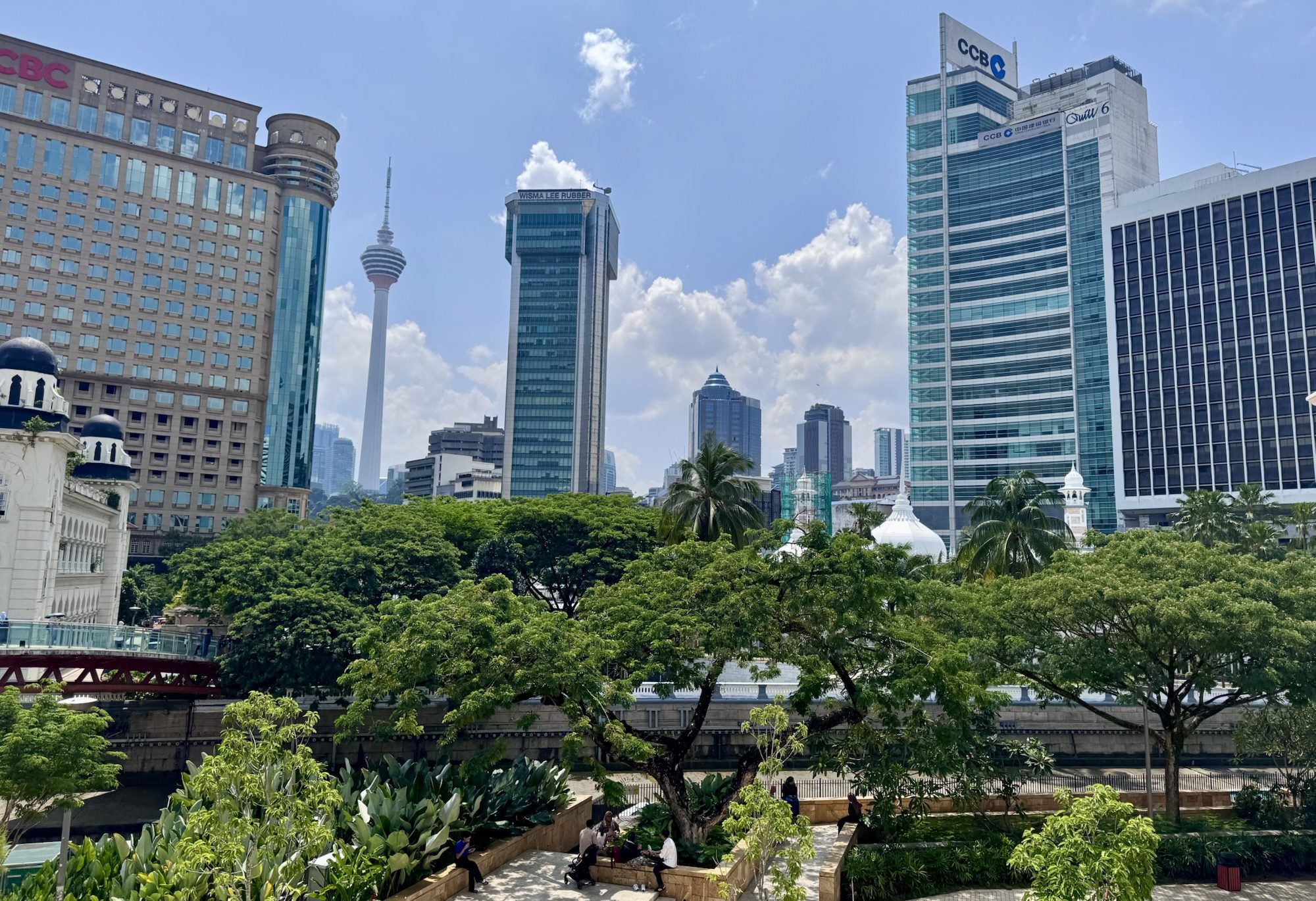
Situated at the western midpoint of Peninsular Malaysia, Kuala Lumpur is an international metropolis whose multifaceted identity is a captivating collage of native Malay, Chinese, Indian, and British colonial influences.
Muslim foundations and Malay food
As the capital and largest city of a predominantly Muslim country, Kuala Lumpur boasts beautiful Islamic-inspired architecture such as the Sultan Abdul Samad Building and Masjid Jamek. Even the design of the world-famous Petronas Twin Towers draws on traditional Islamic geometry.

Sultan Abdul Samad Building as captured from Kuala Lumpur’s iconic Merdeka Square.
An Islamic star fountain in the courtyard of the Sultan Abdul Samad Building.


Modern office blocks tower over Masjid Jamek at the River of Life confluence.
In recent decades, the city has become a popular destination for tourists and migrants from the Arabian Peninsula, adding a distinct new layer to an already-rich cultural tapestry. This is particularly evident in the central Bukit Bintang district, with its shawarma spots, shisha lounges, and Arabic signage.
However, Malaysia’s Arabic connections go back a lot further than that. It was Arab merchants who introduced Islam to the country in the 13th century.
Due to its colonial origins, Kuala Lumpur has a lower share of practising Muslims than the national average, but its Muslim-Malay identity nonetheless thrives in pockets throughout the city. The most famous of these is Kampung Baru – a historic Malay enclave in the shadow of the Petronas Towers.
Amid Kuala Lumpur’s rapid growth and modernisation, this small community has resisted decades of pressure to vacate the land for urban development. To this day, Kampung Baru stands as a bastion of wooden stilt houses in an ever-expanding landscape of glass and steel. It also happens to be home to some of the tastiest nasi lemak – Malaysia’s national dish – Kuala Lumpur has to offer.
A typical residential road in Kampung Baru, with the Petronas Twin Towers looming in the background.


The tiled rooftops of Kampung Baru.
A classic nasi lemak from Wanjo in Kampung Baru, featuring curry-coated fried chicken, coconut rice (nasi lemak itself), fried egg, cucumber, sambal sauce, and peanuts with fried anchovies. Yum.

Taoist temples and Chinese toast
Existing side by side with Kuala Lumpur’s Muslim demographic is a significant ethnic Chinese population. Having first arrived in the 19th century, Chinese settlers established temples, markets, and food stalls to bring a slice of their old way of life to their new home.
Today, Kuala Lumpur’s Chinatown is one of the city’s liveliest districts. In the area surrounding the vibrant Central Market and bustling Petaling Street Market are snazzy cocktail bars, traditional cafés, and abundant street art.

Petaling Street Market at the heart of Kuala Lumpur’s Chinatown.
Street art near Kuala Lumpur’s Central Market.


The mystical interior of the Taoist Sin Sze Si Ya Temple on the edge of Chinatown, Kuala Lumpur.
Yet Kuala Lumpur’s Chinese identity is not confined within the borders of Chinatown. Rather, it is woven into the very fabric of the city. This is perhaps most apparent in Kuala Lumpur’s Chinese-influenced cuisine – and in one delicacy above all: kaya toast.
Although most strongly associated with Singapore, kaya toast is a Hainanese-Chinese innovation that blends British culinary conventions with quintessentially Malay components.
Kaya – a luxurious coconut jam – is spread on two slices of toasted bread that hold between them a generous slab of rich butter. Traditional kopitiams typically serve the sandwich with two runny eggs in a bowl, to which the diner can add soya sauce and white pepper to taste. The seasoned eggs then act as a dip for the toast, and it’s all washed down with a cup of strong, thick kopi (coffee).
This is an admittedly curious combination of sweet and savoury, but to say it ‘works’ would be an understatement. Kaya toast is more than just a delicious breakfast dish; it’s the Malay Peninsula’s indigenous, Chinese, and colonial heritage on a plate.
A typical kaya toast set – the very first I ever tried – from the Ali, Muthu & Ah Hock kopitiam chain.


A kaya set from Hock Kee – a more upmarket, heritage-style kopitiam chain where the kopi is served with fish-shaped savoury biscuits.
Chinatown street art representing Kuala Lumpur’s kopitiam culture.

Brickfields spice and Batu Caves
Although the smallest of Kuala Lumpur’s top-three demographics, the local Indian population has had a significant impact on the city’s make-up – quite literally. In the late 19th century, waves of South Indian labourers arrived to work in the recently established Brickfields district, where they manufactured bricks and constructed much of the city as we know it today.
As the beating heart of Kuala Lumpur’s (not so) Little India, contemporary Brickfields is a colourful homage to the real thing. Flanking the arch-lined streets are multi-storey shops complete with busy signage and Bollywood music. These stock everything from traditional clothing and kitchenware to heady incense and aromatic spices. While roadside stalls sell decorative jasmine garlands, fresh roti, and steaming chai, local restaurants serve up the best biryani in Kuala Lumpur. Brickfields is – in the best possible way – a complete sensory overload.

The Torana Gate, gifted to Malaysia by the Indian government in 2015, welcomes visitors to Brickfields.
A fresh cup of chai from a Brickfields street stall.


Chennai-style chicken biryani from Original Dum Briyani, Brickfields.
Arguably the most remarkable example of Indian cultural heritage in the Kuala Lumpur area, however, lies just north of the city proper, in the neighbouring district of Gombak, Selangor state.
Gombak is home to the famous Batu Caves – a geological marvel carved into densely forested limestone cliffs that rise dramatically from the urban sprawl. Around 35 minutes from Kuala Lumpur Sentral by KTM Komuter train, the site functions as the religious focal point for the city’s Tamil Hindu community.
Visitors access the main cave via 272 rainbow-coloured steps, at the base of which stands a 42.7-metre golden statue of Hindu deity Lord Murugan. The true sentinels of the stairs, though, are the mischievous long-tailed macaques, whose brazen bag-grabbing antics force tourists to think twice about bringing comestibles into the caves.
The long slog up the steps is worth the profuse sweating and simian-induced stress that accompany it. Despite often being crowded with visitors, Batu Caves is a deeply spiritual place where Hindu temples and shrines have made their home in spectacular natural surroundings. In my opinion, it should be top of the to-do list for anyone spending more than a day in Kuala Lumpur. And given how much there is to do, see, and taste in this city of contrasting cultures, one day in KL is never enough.
Lord Murugan stands guard over the 272 steps leading up to the Batu Caves entrance.


Sunlight pours in from a natural opening in the roof of Batu Caves.
A mother long-tailed macaque cradles her baby atop a golden post on the Batu Caves staircase.

Find out where Kuala Lumpur ranks among my favourite Southeast Asian metropolises in Three Southeast Asian cities I can’t get enough of. For a quieter side to the region, see Eight must-see smaller destinations in Southeast Asia.

Share your thoughts: