
Southeast Asia has something for every kind of traveller – from the most casual to the most intrepid. While I’ve previously ranked my favourite smaller destinations in the region, in this article, I discuss the three Southeast Asian cities I’ll simply never get bored of…
3. Kuala Lumpur, Malaysia

I first visited Kuala Lumpur in 2022, on a month-long tour of Southeast Asia with my partner, Maria. Sandwiched between three weeks in Thailand and a week in Singapore, our stay in the city was sadly short-lived. However, it was enough to give me a taste of what the place is all about – and to leave me craving more. I finally returned, this time with my dad, en route to Australia in 2026.
Situated at the western midpoint of Peninsular Malaysia, Kuala Lumpur is a former British outpost that is today home to significant Malay, Chinese, and Indian populations. All of these cultures have left an indelible mark on the city’s make-up, resulting in a civic identity that bears characteristics of each – and yet remains distinctly Kuala Lumpurian.
Serving as Kuala Lumpur’s beating heart are Merdeka Square and the adjacent Chinatown. The former is an open-air museum of colonial and Islamic-inspired architecture, while the latter is a lively maze of busy market stalls, trendy cocktail bars, traditional cafés, and sacred temples.

The majestic Sultan Abdul Samad Building, pictured from within its courtyard.
A crowded Petaling Street Market at the heart of Kuala Lumpur’s Chinatown.

North-east of Merdeka Square, in the shadow of Kuala Lumpur’s Petronas Twin Towers, is Kampung Baru. Amid the city’s rapid growth and modernisation, this Muslim-Malay enclave has resisted decades of pressure to vacate the land for urban development. To this day, it stands as a bastion of wooden stilt houses in an ever-expanding landscape of glass and steel.

The iconic Petronas Towers – the world’s tallest twin skyscrapers.
A typical street in Kuala Lumpur’s Kampung Baru neighbourhood, just minutes away from the Petronas Towers.

Despite being the smallest of Kuala Lumpur’s three major ethnic groups, the local Indian population has had an equally tangible impact on the city’s identity. Brickfields, the cultural core of Little India, is a vibrant homage to the real thing – a sensory explosion of colourful arches and floral garlands, heady incense and aromatic spices, clattering crockery and Bollywood beats.

The vibrant Jalan Tun Sambanthan, Brickfields’ main thoroughfare.
Colourful garlands and bouquets on display in a Brickfields flower market.

Just north of the city proper lies Batu Caves. As the religious focal point for the city’s Tamil community, it’s a deeply spiritual site where Hindu temples and shrines have made their home in spectacular natural surroundings.
Accessing the caves involves scaling 272 steps in the tropical heat and humidity – while keeping any food or drink you may be carrying beyond the reach of the local long-tailed macaques. Don’t let this put you off, though. The mystical atmosphere and awe-inspiring views inside the main cave more than compensate for the sweaty, monkey-dodging climb up to the entrance.

Lord Murugan stands guard over the 272 steps leading up to Batu Caves.
An eye-shaped opening in the high ceiling of Batu Caves.

2. Singapore

Singapore is the first place I ever visited in Southeast Asia. I spent roughly a day and a half there either side of a 16-day tour of New Zealand with my dad in 2019. It left such an impression on me that I returned three years later with Maria, staying for a week to draw our Southeast Asian adventure to a close.
Like Kuala Lumpur, Singapore was once a British outpost and is populated primarily by Chinese, Malay, and Indian ethnic groups. Buddhism has a larger footprint here than in the Malaysian capital – a reflection of Singapore’s Chinese majority – but Islam still has a strong presence, as do Hinduism and, to a lesser extent, Christianity. This gives the island city-state the same multifaceted identity that makes KL so appealing.
Singapore is famed for its cleanliness and modernity. Locations such as the Central Business District (CBD), Marina Bay, and Gardens by the Bay embody this reputation. Even Singapore Changi Airport is as cutting-edge as airports come. However, many visitors use these qualities as a criticism, claiming they somehow detract from the city-state’s authenticity.

Singapore’s national symbol, the Merlion, looking out over a moonlit Marina Bay.
The Supertree Grove at Gardens by the Bay, with Marina Bay Sands in the background.


Changi Airport’s Rain Vortex, part of the Jewel complex, which hosts nightly light and sound shows.
I disagree wholeheartedly. Lots of Asian cities are spotlessly clean and ultra-modern. Look at the gleaming metropolises of Japan and South Korea, or the futuristic megacities of China. Besides, alongside its glossy skyscrapers and high-end shopping centres, Singapore possesses an abundance of heritage architecture, cultural assets, and wild nature spots. If this isn’t ‘authenticity’, I’m not sure what is.
Visitors keen to experience the city’s more traditional side need look no further than Chinatown. Adjacent to the CBD, the historic neighbourhood is known for its colourful Sino-Portuguese shophouses and vibrant hawker street food culture. It’s also home to the impressive Buddha Tooth Relic Temple and the wonderfully ornate Sri Mariamman Hindu Temple.
Mid-Autumn Festival lanterns hang over South Bridge Road on the edge of Singapore’s Chinatown, where historic Sino-European shophouses sit in the shadow of the CBD’s modern skyscrapers.


The illuminated tiers of the Buddha Tooth Relic Temple viewed from an alleyway in Singapore’s Chinatown.
Tables in the exterior corridor of the Buddha Tooth Relic Temple laden with edible offerings for the departed during Singapore’s Hungry Ghost Festival.

As a country – not just a city – Singapore has plenty to offer outside its urban centre. Just off the mainland are several islands that, although compact, are brimming with history.
Take a 30–45-minute ferry trip from Marina South Pier near the CBD to reach Saint John’s Island Complex. At the centre of this mini archipelago are the islands of Lazarus and Seringat – now technically a single island joined by a man-made beach. To the north-west of Seringat, the tiny Kias Island offers views of Sentosa and the Singapore waterfront, while Kusu, east of Lazarus, features an enchanting Chinese temple and tortoise sanctuary.

The white sands of the crescent-shaped Lazarus Island Beach, one of the most secluded coastal escapes in Singapore’s Southern Islands.
The Da Bo Gong Chinese temple on the shores of Kusu Island, a sacred pilgrimage site famed for its tortoise sanctuary.

Connected to Lazarus by a paved causeway is Saint John’s itself. A holiday resort that also hosts Singapore’s National Marine Laboratory, Saint John’s served as a quarantine station between the 1870s and 1970s, an internment camp for political prisoners of the British Empire following the Second World War, and an Opium Treatment Centre from 1955 to 1975. Despite – or indeed because of – its dark and varied past, the island makes for a fascinating day trip.
To step even further back in time, take a boat from Changi Point Ferry Terminal in the east of Singapore to the forested island of Pulau Ubin. Mostly uninhabited, Ubin provides a window into Singapore’s pre-colonial history. Visitors arrive at a small, well-preserved village, where they can rent a bike to cycle around the entire island.
With its temples, trails, wetlands and wildlife, Pulau Ubin is a must-visit for anyone spending more than a couple of days in Singapore. Just beware of the long-tailed macaques. The mischievous monkeys are even more brazen here than in KL – and will take any opportunity to snatch food and drink from ill-prepared tourists…

Exposed mangrove roots at low tide along the protected Chek Jawa Wetlands on the eastern coast of Pulau Ubin, Singapore.
A pair of native oriental pied hornbills perched on the branches of a sea almond tree on the rural island of Pulau Ubin.

1. Bangkok, Thailand

As the first city I visited with Maria on our grand tour of Southeast Asia in 2022, Bangkok holds a special place in my heart. We spent almost two weeks in the Thai capital on that trip, but we could’ve happily stayed there for longer. In 2025, while living in Chengdu, China, we returned for a few days and revisited some of our favourite spots.
Unlike Malaysia and Singapore, Thailand has never been colonised. As a result, Bangkok’s identity is quintessentially Thai, with Theravada Buddhists making up the vast majority of its population. This is not to say the city isn’t multicultural; it also has a sizeable Muslim population, while the Hindu community numbers in the tens of thousands.
However, Bangkok’s unique charm is most closely tied to its enchanting Thai-Buddhist architecture and profound spirituality. In among the soaring skyscrapers and sprawling shopping centres is an abundance of stunning temples and sacred monuments. This ensures that, even in a city of such immense scale, beauty and history are to be found around every corner.

The ornate roofs of Wat Hua Lamphong nestled between modern commercial buildings in Bangkok’s CBD.
The 32-metre Luang Pho To standing Buddha statue at the heart of Wat Intharawihan. We stumbled upon this towering monument after eating at the nearby Krua Apsorn, which featured in an episode of The Hairy Bikers’ Asian Adventure.


The opulent Wat Benchamabophit, commonly known as the ‘Marble Temple’, around 20 minutes by foot from Wat Intharawihan.
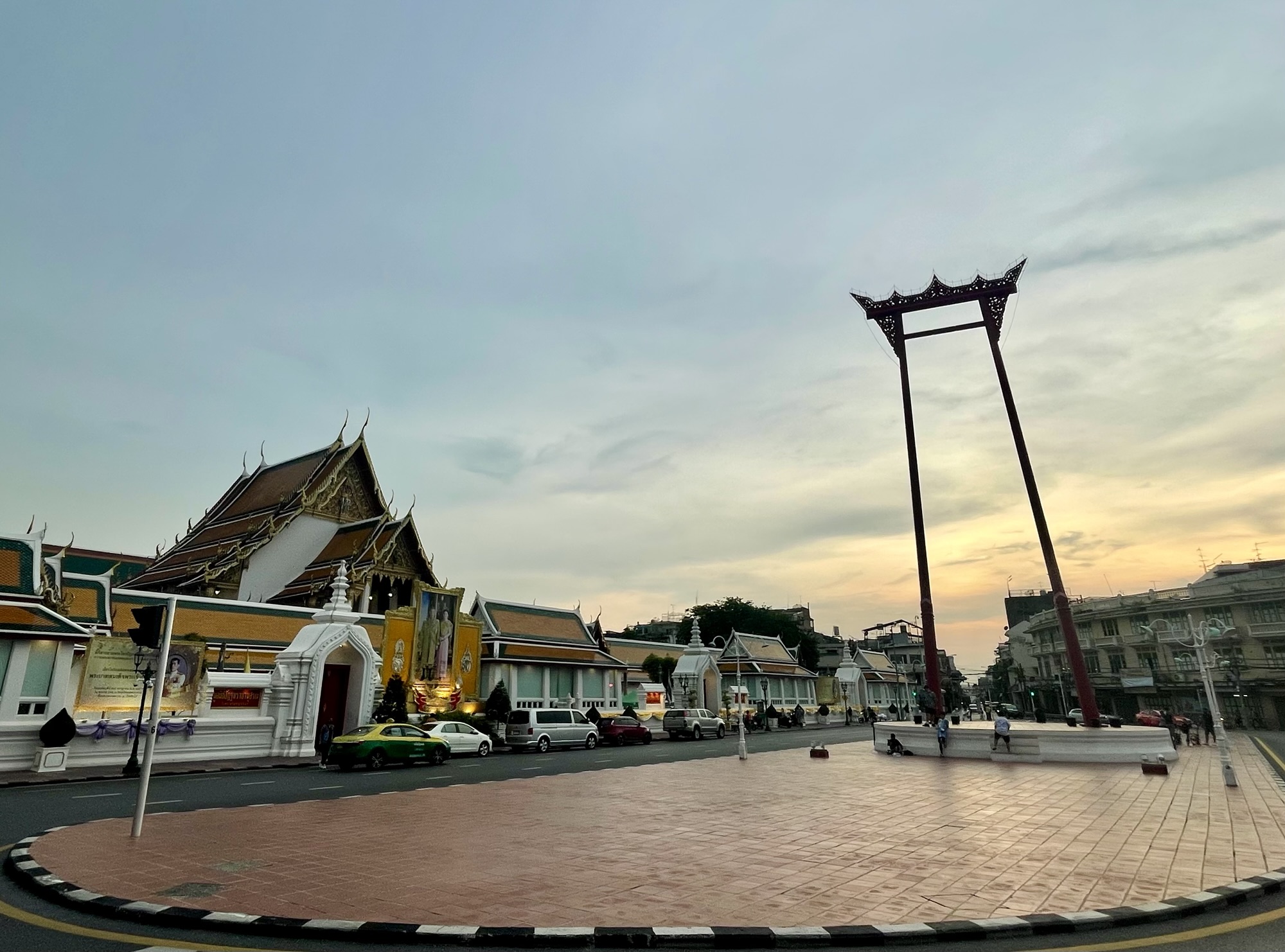
The cultural and spiritual heart of Bangkok is Phra Nakhon on the western side of Rattanakosin Island. Wat Saket, while technically just outside of Phra Nakhon, is a great first stop for anyone exploring the historic district. The temple complex is best known for its Golden Mount – an incredible shrine-topped hill offering panoramic views of the city. Around a 10-minute walk west of Wat Saket is the iconic Giant Swing and the adjacent Wat Suthat. Less than 20 minutes further west is the remarkable Grand Palace, one of Bangkok’s premier attractions. Right across the Chao Phraya River, in the neighbouring Bangkok Yai district, is the inimitable Wat Arun.
The gleaming chedi (stupa) at the summit of the Golden Mount, an artificial hill in Bangkok’s historic city centre.


An intricate Chinese stone pagoda in Wat Suthat’s sumptuous courtyard, with the grand columns of the main ordination hall rising in the background.
The Grand Palace’s Chakri Maha Prasat Throne Hall, featuring a Western European façade and Thai-Buddhist roofs, with the golden Aphorn Phimok Prasat Pavilion in the foreground.


The towering central prang of Wat Arun, the Temple of Dawn, with one of its four secondary spires in the foreground.
From Phra Nakhon, follow the narrow and seemingly unending Sampheng Market south-east to Chinatown. Centred on the broad, canyon-like Yaowarat Road – complete with neon lights and food-stall-lined side streets – Bangkok’s Chinatown makes its Kuala Lumpur- and Singapore-based counterparts seem positively serene.
The charismatic chaos of Yaowarat Road, Chinatown Bangkok, at sunset.


A neon-lit Yaowarat Road on a rainy evening at the peak of Thailand’s monsoon season.
For all of Bangkok’s hustle and bustle, visitors can find oases of tranquillity, too – and not just in the temples. The Thai capital is dissected by an extensive network of canals. As well as offering an incredibly cheap and convenient way of traversing the city, canal boats provide temporary respite from the street-level chaos.
The illuminated waters of Khlong Saen Saep canal cut through Bangkok’s historic neighbourhoods towards the skyscrapers of Pratunam.

Hop off the boat at Pratunam Pier in Bangkok’s commercial district and shelter from the afternoon sun in centralwOrld or one of the other flashy shopping centres in the area. In the early evening, when the temperature drops slightly, take a leisurely stroll around the amazing Lumphini Park. Less than 20 minutes from centralwOrld by foot, Lumphini is famous for its Asian water monitor lizards. These massive reptiles are expert swimmers and are commonly spotted in the park’s lakes or resting on their shores. They’re a sight to behold, but always keep a respectful distance – for their sake and your own!

An Asian water monitor lizard glides through the main lake of Lumphini Park, where the modern towers of the Silom financial district provide a contrasting backdrop.
A large monitor lizard rests on the muddy bank of the lake.

Have you visited any of these Southeast Asian cities? If so, what do you think of my ranking? If not, and you’d like to visit them, feel free to ask any questions regarding logistics or recommendations in the comments below. Or, click here for more Southeast Asian inspiration.
Share your thoughts: