
In this three-part travelogue, I recount the 16-day bus tour of New Zealand my dad and I took in 2019 – from Auckland in the north down to Queenstown in the south. In the first instalment, I recall our experiences on the North Island.
New Zealand – ‘Aotearoa’ in Māori – had been at the top of my dad’s bucket list since he was a child. When he finally made it there in October 2019, I was lucky enough to join him.
As explained in the first part of my West Africa travelogue, my dad prefers to book his trips with travel agencies. On this occasion, the trusty Trailfinders put us together a 19-day itinerary comprising a 16-day coach tour of New Zealand – organised by the excellent AAT Kings – with a 36-hour stop in Singapore either side. Around three-and-a-half months and one considerable hit to my dad’s bank account later, we were on our way.
Auckland and the Bay of Islands
Having flown from Manchester to Auckland via Singapore, we began our Aotearoa adventure on the North Island – ‘Te Ika-a-Māui’ in Māori. We didn’t have much time in New Zealand’s largest city given our packed itinerary, but I found Auckland to be a vibrant, cosmopolitan place.
On our first day in the city, we strolled around the central business district (CBD) and visited the Sky Tower for views over the harbour.

The tour began in earnest on the second day, when we boarded the bus bound for Paihia in the Bay of Islands. On the way there, we stopped for a toilet break in Kawakawa – a town noted for being the one-time residence of Austrian artist and architect Friedensreich Hundertwasser.
‘Why is he bothering to mention a toilet break?’ you may – quite justifiably – be wondering. Well, these were no ordinary toilets; these were the Hundertwasser Toilets – conceived and designed by Friedensreich himself.

The entrance to the gents’ side of the Hundertwasser Toilets, Kawakawa.
Inside the Hundertwasser Toilets.

The Hundertwasser Toilets are both a work of art and, well, toilets. Making use of the fabulous facilities was an exciting moment for me; I’d done an art project on Hundertwasser at school and years later visited the iconic Hundertwasserhaus in his (and my dear Großmutter‘s) hometown of Vienna.
So, having spent a penny in a toilet I’d have quite happily paid a pound to use, I contentedly hopped back on the bus. Not long afterwards, we reached Paihia – the gateway to the Bay of Islands.
Located in Te Ika-a-Māui’s Far North District, the Bay of Islands boasts a subtropical climate and an abundance of lush greenery. This gives it a Jeju-like feel that contrasts sharply with the cool, rugged southernmost reaches of New Zealand’s South Island.
Soon after arriving in Paihia, we headed out on a catamaran cruise to Motukōkako Island, nicknamed ‘the Hole in the Rock’.

The short trip to Motukōkako took us past some of the many islands (approximately 150) from which the region derives its name.

By the time our destination was in view, our boat had attracted the attention of some friendly locals – the majestic bottlenose dolphins.

A bottlenose dolphin escorts us to our destination.
Our cetacean escort accompanied us part way to the island before leaving us in the capable hands of our captain. Given the favourable weather conditions, the skipper deemed it a good opportunity to ‘thread the needle’ – that is to say, to navigate the sizeable vessel through the 16-metre Hole in the Rock…
As you can see (and hear) from the video, the boat and everyone on board made it through the Hole in one piece. Later, back in Paihia, we visited the Waitangi Treaty Grounds, often considered the birthplace of modern New Zealand, before settling down for some much-needed rest at the hotel.
The glorious view from our hotel in Paihia.

The next day, we awoke to decidedly less pleasant conditions. Springtime in Aotearoa is characterised by its changeable weather.

While the rain dampened our clothes, it did nothing to dampen our spirits. Following breakfast, we took a ferry across the bay to the small town of Russell – Kororāreka – New Zealand’s first European settlement and one-time capital.
It’s hard to believe that this quaint little town was once a lawless frontier and haven of debauchery known as the ‘Hell-hole of the Pacific‘…

A pillory installed as a nod to Kororāreka’s ‘lawless’ past.
Day four of the tour saw us climb back on the coach to return to Auckland. On the way, we stopped at Claphams National Clock Museum in Aotearoa’s northernmost city, Whangārei, where we met a staff member who, like us, was born in Liverpool and supported Liverpool FC. Small world!
The quirky Clock Museum in Whangārei.

From Whangārei, we headed to the Parry Kauri Park in Warkworth, where visitors follow a boardwalk path through the remnants of a kauri forest. The New Zealand kauri is – as the name suggests – native to the country, and the Parry Kauri Park is home to some of the largest specimens around.

The magnificent McKinney Kauri, thought to be over 800 years old.
On day five, we took a final look around central Auckland before hitting the road again – in the direction of Rotorua.
Auckland Sky Tower as viewed from Myers Park in the CBD.


Auckland War Memorial Museum.
En route to Rotorua
As much as I prefer to travel under my own steam, traversing Aotearoa by coach is a convenient way to experience the country. It allows you to sit and absorb its diverse scenery without the distractions that come with driving or navigating yourself.
Te Ika-a-Māui is known for its verdant, rolling hills. I was surprised to learn, however, that the grasses carpeting much of the North Island were imported by English settlers in the 19th century to feed livestock.

An organised tour also provides an opportunity to visit fascinating places you might miss if relying on public transport. The Parry Kauri Park is one such location; another is the Glowworm Caves in the village of Waitomo.
A pouwhenua – traditional Māori carved post – at the Waitomo Glowworm Caves Visitor Centre.

Part of an extensive limestone cave system, the Waitomo Glowworm Caves are home to the Arachnocampa luminosa – a species of glowworm unique to New Zealand. Tourists can take a boat tour through the grotto to see the little larvae sparkling in the dark, like stars against the night sky. Curiously, the glowworms elude a direct gaze, their bioluminescence perceptible only in the edges of the viewer’s vision. This gives the insects an ethereal quality that, combined with the serenity of floating silently through the cavern, makes the Glowworm Cave tour an almost transcendental experience.
Out of our reverie and back in the real world, we made one last stop before reaching Rotorua – at the Arapuni Power Station and Dam, a historic hydro plant with an infamous, swaying suspension bridge.

Arapuni Power Station, pictured from the suspension bridge.
I managed to steady myself for just long enough to take this photo of Arapuni Suspension Bridge.

Shortly after departing Arapuni, we arrived in Rotorua. Situated in Te Ika-a-Māui’s Bay of Plenty region, Rotorua is a small city that punches above its weight as a cultural and geological powerhouse.

Lake Rotorua, the lake on which the city lies.
The settlement is considered the heartland of Māori culture, with over 40% of its approximately 74,000 inhabitants belonging to the Māori ethnic group – more than twice the national average. Built inside a volcanic caldera, it’s also a hotbed of geothermal activity.
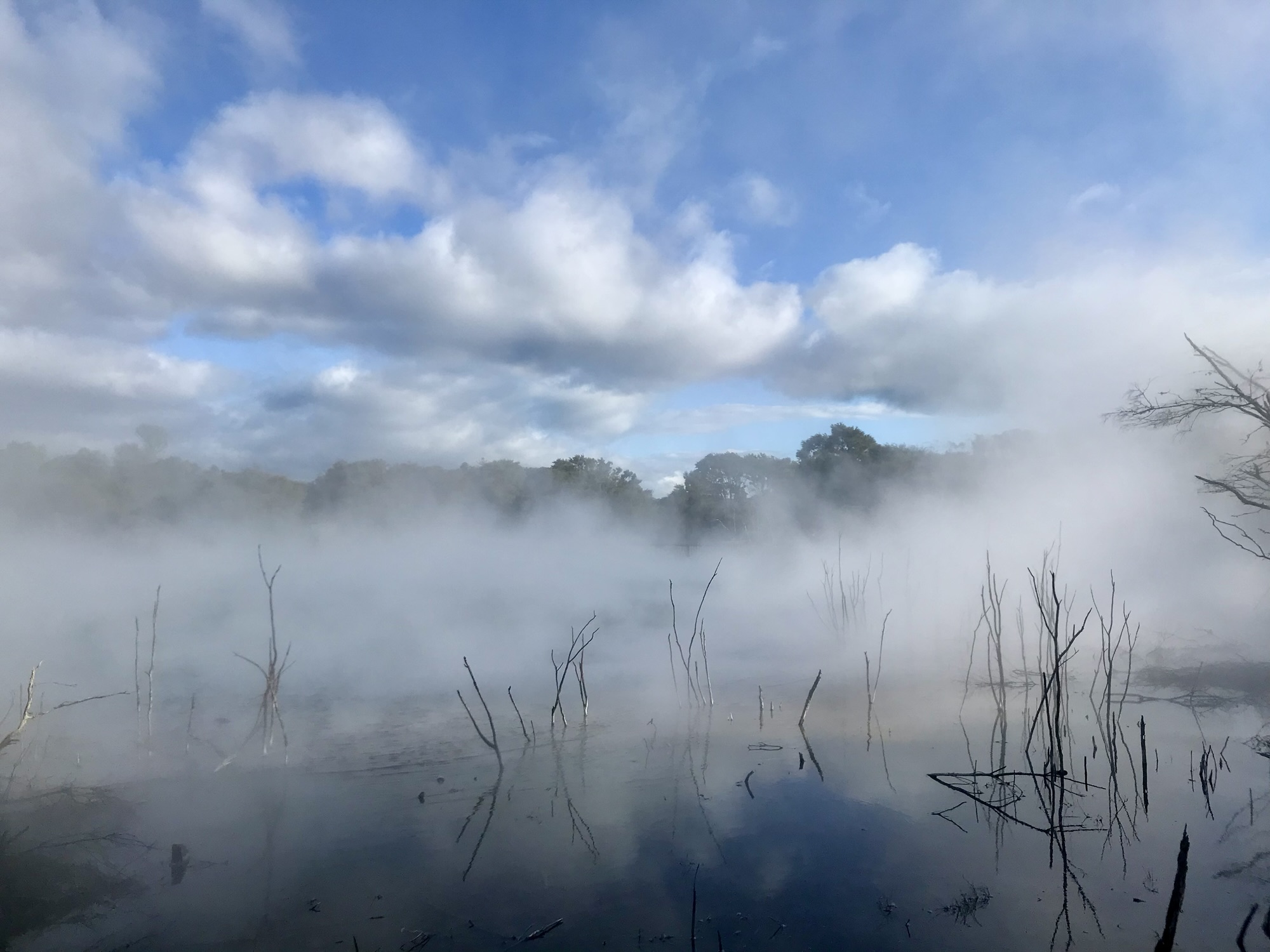
In fact, one of the first things you notice on arriving in Rotorua is the pungent scent of sulphur, which is especially strong around the city’s geothermal pools. Much to our nostrils’ chagrin, we visited Kuirau Park, New Zealand’s only free geothermal park, for a closer sniff.

Stench notwithstanding, Kuirau Park is a hauntingly beautiful place that visitors to Rotorua should have high on their to-do list. Moreover, given the site’s central location within the compact city, it’s practically impossible to miss.
Be thankful you can’t smell this photo of Kuirau Lake.

On the evening of our first day in Rotorua, we visited the nearby Tamaki Family Marae – now known as ‘Te Pā Tū‘ – a Māori village set within an ancient tawa forest. There, the locals received our tour group with a haka pōwhiri before their leader touched noses with our nominated ‘chief’ in a traditional hongi greeting.

Tamaki Māori performing a haka pōwhiri to welcome our tour group.
After welcoming us into their domain, the Te Pā Tū residents showed us around the village and taught the men in our group how to perform a haka. I have no photographic or video evidence of this (even if I did, it would never see the light of day), so you’ll have to take me at my word that my haka gave the All Blacks rugby team a run for their money.
Next, the villagers treated us to a kapa haka – a concert combining storytelling with song and movement. In an impressive display of dexterity and coordination, the performers threw wooden rākau sticks to each other in time with the music. They then sang traditional songs, with the women skilfully twirling poi – weighted balls on the end of strings – before the men reminded us how a real haka is done in an earth-shakingly resonant finale.
Whether powerfully performed or – in my case – feebly attempted, a haka is hungry work, so my eyes lit up at the sight of steaming chicken and vegetables being lifted from hāngī ovens in the ground.
Our hearty feast before being cooked using the traditional Māori hāngī method of underground steaming.

The hāngī cooking method imparts a wonderfully earthy, smoky flavour to foodstuffs that are otherwise mostly familiar to visitors from elsewhere in the Anglosphere.

Without the corn on the cob and cornbread, this might look like a traditional British or Irish Sunday roast – but the flavour was distinctly Māori.
Our evening at Te Pā Tū provided an informative and engaging insight into Māori customs, and we returned to Rotorua well fed and thoroughly entertained.
In the morning of our second day in the city, we attended the Farm Show at Rotorua’s Agrodome theme park, where visitors learn about New Zealand’s biggest industry: agriculture.

After the show, my dad and I used our free time to explore central Rotorua before heading to the Dansey Road Scenic Reserve for a Rotorua Canopy Tour – an optional extra that proved worthy of the additional cost.
Rotorua Museum, which has been closed for earthquake proofing since 2016, in the Government Gardens.


The Blue Baths, also located in Rotorua’s Government Gardens.
While walking through the reserve, we learnt about its pest control and restoration efforts, which aim to encourage indigenous flora and fauna to thrive anew in the ancient Ōkoheriki Forest. The route took us along the forest floor, up onto elevated walkways, and across wooden swing bridges. At one point, the guide called down a North Island robin – toutouwai – to feed directly from our palms.

The highlight of the Canopy Tour, however, was zip-wiring among the native rimu and tawa trees. I wouldn’t call myself an avid thrill-seeker, and as adrenaline-fuelled activities go, zip-wiring provides a relatively mild rush. Nevertheless, soaring from one ancient tree to another, through the canopy and over deep gullies, was both exhilarating and awe-inspiring.
‘The Flutter’, the fourth and longest zip-wire on the Original Canopy Tour, takes you 220 metres over a fern-filled gulley.

The Canopy Tour turned out to be a fittingly epic way to conclude our time in Rotorua. After breakfast the next morning, we left for our final stop on the North Island: New Zealand’s capital, Wellington.
Last stop: Wellington
Rotorua to Wellington was the longest single trip on our entire tour of New Zealand, so it was a good job we made a series of superlative stops along the way.
Our first was at the stunning Huka Falls. Aotearoa’s most powerful waterfall, Huka is situated at a chokepoint on the country’s longest river, the Waikato, and sees an average of 220,000 litres of water cascade over its 11-metre drop each second.

Huka Falls, near Taupō, Te Ika-a-Māui.
Mere minutes from Huka by road is Lake Taupō, whose perfectly still, mirror-like surface provides a striking juxtaposition to the furious, frothing falls.

The lake’s apparent tranquillity also belies its cataclysmic creation. Taupō owes its existence to massive historical eruptions of the supervolcano that shares its name. So ‘super’ is this volcano that the lake it created – by causing the land to collapse in on itself – is New Zealand’s largest by surface area at over 600 square kilometres (roughly the size of Singapore).
Back on the coach and heading south, we took State Highway 1, the Desert Road, across Te Ika-a-Māui’s Central Plateau – a dramatic landscape of alpine desert and snow-capped volcanoes. This is one part of the North Island where imported grass has failed to flourish. Instead, the high altitude and ashy soils accommodate only the hardiest vegetation, such as the native red tussock.
Rising above the Rangipō Desert is the North Island’s tallest peak, Mount Ruapehu, which reaches an elevation of around 2,800 metres.

From the epic to the eccentric, our next stop was the tiny town of Taihape – the self-proclaimed ‘Gumboot Capital of the World’.
‘Gumboot’ is the Antipodean term for what we Brits know as ‘wellies’ – Wellington boots – named after the same duke from whom New Zealand’s capital derives its name. Given Taihape’s relative proximity to Wellington, I really think the Kiwis missed a trick here!
Wellington may be the capital of New Zealand – but Taihape is the Wellington capital of the world!

Perhaps this is a matter we should’ve taken up at the New Zealand Parliament Buildings, which we visited the morning after arriving in the capital.
The most iconic of the Parliament Buildings – and possibly the most iconic of all buildings in Wellington – is the brutalist Executive Wing. More commonly known as ‘The Beehive’ on account of its layered, circular form, the Executive Wing was built in 1977 as an extension to Parliament House. Due to cost concerns associated with World War I, Parliament House was never completed to its original design, leaving it with an asymmetrical, unfinished look.

The brutalist Executive Wing/Beehive, Wellington.
The Edwardian neoclassical Parliament House, whose south wing, originally intended to mirror the north (on the right of this picture), was never built.

Immediately north of the Edwardian neoclassical Parliament House is the Victorian Gothic Parliamentary Library, the oldest building in the parliamentary precinct and arguably the most beautiful (in the conventional sense, at least).

The modest scale but significant character of these buildings is an apt reflection of the city of Wellington itself. With a population roughly one-eighth of the size of Auckland’s, Wellington nonetheless has a stately feel befitting a national capital.
Following our short tour of the parliamentary precinct, we headed up to Mount Victoria for stunning views over the city and its harbour.

Far below on the Wellington waterfront, we could see our next stop: Te Papa, Museum of New Zealand. There, we learnt about Aotearoa’s history and wildlife, and took in a fascinating, immersive exhibition on the Australia and New Zealand Army Corps’ World War I Gallipoli campaign. My dad and I then took advantage of some free time to head into the CBD and experience Wellington’s famous coffee scene.

Bohemian central Wellington is a coffee lover’s paradise.
After enjoying a caffeinated beverage in bohemian surroundings, we wound our way back to the waterfront to reconvene with the tour group. This time, it wasn’t the coach we were boarding but a ferry – the Interislander – bound for New Zealand’s South Island. Even as we looked back on eight incredible days in Te Ika-a-Māui, it felt like our adventure was only just getting started.

In the second instalment of this three-part series, ‘South Island cities and sounds’, I recall my journey through the dramatic South Island – from Picton to Milford Sound via Christchurch and Dunedin.

Share your thoughts: