
Tasmania’s capital city often serves as a basecamp for visitors spending a week or more touring the Australian island state. Yet even a short visit to Hobart and its surroundings can provide a rewarding holiday experience – particularly for lovers of nature and wildlife.
Touching down in Tasmania
I travelled to Tasmania in April 2026 during an eight-day stay in Australia with my dad – part of a longer trip that also took in Almaty, Kazakhstan, and Kuala Lumpur, Malaysia. After an early morning flight from Sydney, we touched down in the capital, Hobart, and explored the picturesque city centre.
Since Australia’s national day of remembrance, Anzac Day, had taken place the previous day, the Salamanca Market, which is normally held on Saturdays, had been rescheduled for Sunday, 26 April – our arrival date. This gave us the chance to see the small city of Hobart at its most vibrant and colourful, with the dozens of stalls lining Salamanca Place selling local produce, crafts, clothing, and more.

Kunanyi / Mount Wellington provides a sober backdrop to Hobart’s vibrant Salamanca Market.
Just north of Salamanca Place is Constitution Dock, the smaller of two docks in Sullivans Cove, central Hobart. There, we ate fish and chips overlooking the water and the central business district (CBD) beyond.
Fish and chips, with a side of seafood chowder, overlooking Constitution Dock in central Hobart.


Hunter Street, which runs along the northern edge of Sullivans Cove, features some of Hobart’s most historic architecture.
After lunch, we strolled around the historic waterfront area before returning south, through a now largely deserted Salamanca Place, to Battery Point. Known for its 19th-century architecture, Battery Point is Hobart’s oldest colonial-era suburb, featuring charming hill-top houses and boutique cafés.
Hampden Road at the heart of Battery Point, with the ever-present Kunanyi looming in the background.


The way down from Battery Point took us back through a now-empty Salamanca Place, with its sandstone warehouses and tree-lined lawn, as the sun set over the mountain.
As pleasant as the Hobart waterfront and Battery Point undoubtedly are, we hadn’t come all the way to Tasmania to see heritage buildings similar to those we have at home. What had drawn us to the island was its natural beauty and, above all, the opportunity to spot endemic wildlife.
Touring Maria Island
On our second day in Tasmania, we awoke early to join a tour of Maria Island. (Curiously, ‘Maria’ in this case is pronounced like ‘Mariah’ – as in Mariah Carey of “All I want for Christmas” fame. Good luck getting that tune out of your head…)
Situated off Tasmania’s east coast, around 90 kilometres from Hobart and a short ferry ride from the township of Triabunna, Maria Island is a treasured national park and nature reserve. It has only one settlement, Darlington, which was established in the 1800s as a penal colony and later served as a probation station. Today, the island has no permanent residents, and its only cars are service vehicles. This contributes to a flourishing wildlife population.
In fact, we were only minutes into our island walking tour when we spotted a pair of wombats – a mother and her joey – grazing beside the footpath.
A mother common wombat and her joey grazing beside a footpath in Darlington, Maria Island.


The joey wasn’t afraid to leave its mother’s side for the occasional foray.
Having finally managed to avert our gaze from the adorable marsupials, we proceeded south along the Frenchs Farm Coastal Route to one of Maria Island’s most iconic natural landmarks – the Painted Cliffs. This unusual geological formation takes its name from the multicoloured staining effect caused by iron-rich groundwater seeping through porous sandstone.
The otherworldly scenery of Counsel Creek, just north of the Painted Cliffs, Maria Island.


Looking out over the sandstone shore platform of the Painted Cliffs towards mainland Tasmania.
The Painted Cliffs themselves, with their trademark staining.

Inland from the Painted Cliffs is the old Oast House. Built by convicts in the mid-19th century, the structure was initially used for drying hops for beer brewing. Decades later, following the close of the island’s convict era, an Italian entrepreneur named Diego Bernacchi bought the site to make wine. The winery was short lived, however, and the Oast House has stood as nothing more than a cultural relic for decades.

The ruins of Maria Island’s Oast House.
In contrast, the forest surrounding the ruined building is teeming with life. I spotted several Tasmanian pademelons – similar to wallabies but smaller and fluffier – and a kookaburra that was, quite literally, sitting in an old gum tree.
A Tasmanian pademelon sheltering under branches.


“The kookaburra sits in the old gum tree…”
From the Oast House, we returned to Darlington, where we explored the Coffee Palace – another of Bernacchi’s ill-fated ventures – and some convict-era buildings. At one point, I was standing alone in the Senior Assistant Superintendent’s Quarters, looking wistfully at a taxidermy Tasmanian devil and contemplating how I’d love to see a live one in the wild. Suddenly, my dad appeared at the entrance, imploring me, in hushed tones, to come outside. I did as instructed, stepping as quietly as possible on the old wooden floorboards and carefully crossing the threshold. There, just outside the crawlspace, was a living, breathing ‘Tassie’ staring right back at me.
The power of manifestation: a live Tasmanian devil just metres from where I was looking at a taxidermy one.


The Tassie seemed entirely unfazed by our presence as it bathed in the midday sun.
What made this encounter feel so special was that wild Tasmanian devil sightings in broad daylight are rare. The carnivorous marsupials are nocturnal and shy away from humans. Even our tour guides had never seen one during the day, and told us our only realistic chance of spotting a live Tassie was to visit the Bonorong Wildlife Sanctuary outside Hobart.
Clearly, then, we couldn’t keep our find to ourselves. My dad and I told one of our guides, who was just as excited as we were. He gathered the group, and we led the way back to the spot behind the quarters, where we all stood in silence, observing this elusive creature as it dozed in the sun. That is, until a particularly loud family walked past and scared the poor thing back under the crawlspace. Ah well, it was time to move on to our next stop anyway…
From Darlington, we headed east into the forest. After taking a quick look around the ruins of Bernacchi’s Engine House, I decided to rest on a desiccated log while waiting for the group to reconvene. Just as I sat down, I caught a blur of movement in the corner of my left eye – and immediately shot back up. Turning to look down at the log, I saw two long, fuzzy legs probing from inside a crack mere centimetres from where I’d been. That I hadn’t sat directly above the source of those creepy appendages felt like a lucky escape – even if, in retrospect, they likely belonged to a large but relatively harmless huntsman.
Arachnophobes look away now…

Slightly startled but mostly amused by my close encounter of the eight-legged kind, I joined the group as we made our way northeast towards the Fossil Cliffs at Cape Boullanger. Forming the northern tip of Maria Island, the cape is home to some of the national park’s most recognisable coastal scenery. Before looping back to Darlington, we stopped to take in the ocean views and examine the Early Permian fossils the cliffs are named after.

The towering dolerite columns of Bishop and Clerk, as viewed from Cape Boullanger.
The Fossil Cliffs chasm and the Tasman Sea beyond.


A fossilised shell in the limestone rocks of Fossil Cliffs.
Back in Darlington for the third time, we boarded the ferry to Triabunna and returned to Hobart by minivan. The five or so hours we’d spent on Maria Island had been packed with curious geology, fascinating history, and thrilling wildlife encounters. We genuinely couldn’t have asked for more.
(If you book the same tour as us, via this GetYourGuide link, we’ll earn a small commission – at no additional cost to you.)

Kunanyi and Queens Domain
Our short stay in Hobart would’ve felt incomplete without a visit to Kunanyi / Mount Wellington. The 1,271-metre mountain dominates the city’s skyline, visible from almost every part of town. On our third and final day in Tasmania, we took the Kunanyi/Mt Wellington Explorer Bus to the summit.
The 2.5-hour return tour offered a convenient way of experiencing the mountain in the limited time we had available. Our driver was both a font of local knowledge and a natural entertainer, his informative commentary peppered with witty one-liners. We made a couple of brief photo stops on the way up before spending half an hour exploring The Pinnacle.
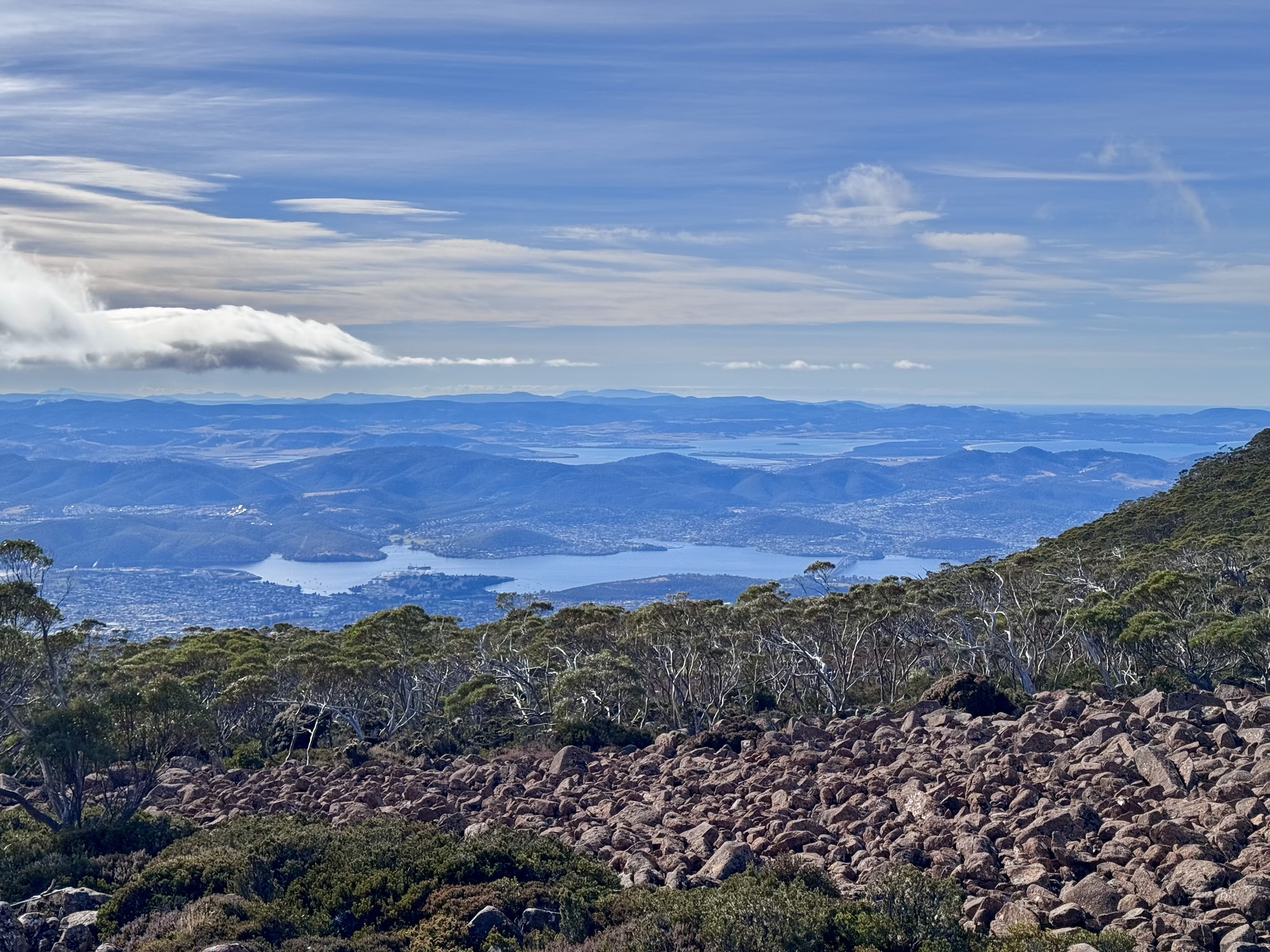
The view over Hobart and its surroundings from our second Kunanyi photo stop.


A view from The Pinnacle.
Striking dolerite formations on the summit plateau.

When the bus dropped us back in Hobart in the early afternoon, we still had a few hours to spare ahead of our flight to Sydney. After exploring the immersive Tasmanian Museum and Art Gallery, we collected our luggage from the hotel and made our way to the Queens Domain.
A short walk from the CBD, this 230-hectare public reserve is a protected pocket of native bushland within the city limits. Crossing the park’s outer reaches, we spotted some local birdlife in the canopy. Beyond the treeline to our right, we could see the Tasman Bridge – Tasmania’s tallest structure – spanning the River Derwent.

An eastern rosella in the Queens Domain, Hobart.
The Tasman Bridge, pictured from the Queens Domain.


A sulphur-crested cockatoo in the canopy. While ‘exotic’ to us Brits, these birds are quite common in Australia.
At the heart of the Queens Domain are the Royal Tasmanian Botanical Gardens, where we spent our final hour in Hobart admiring the diverse flora. The gardens’ dense foliage and ample lawn space also provide a haven for several endemic animal species. Tasmanian native hens, which we’d first come across on Maria Island, can be seen ambling around the lawns. When threatened, these chicken-like fowl can reach speeds of 50 kilometres per hour, earning them the local tag of ‘turbo chooks’.
The Japanese garden within the Botanical Gardens complex.


The multicoloured autumn leaves of the Botanical Gardens frame the distant Mount Wellington.
A group of ‘turbo chooks’ ambling around a lawn in the Royal Tasmanian Botanical Gardens.

Far less common than the Tasmanian native hen – especially during the day – is the southern brown bandicoot. In yet another stroke of luck, we found one of the diminutive, nocturnal marsupials snuffling around in a garden bush shortly before we left for the airport. The moment encapsulated the serendipity that had characterised our entire stay in Tasmania. We may have spent barely three days in the island state, but I can confidently say we made the most of them.

A southern brown bandicoot snuffling around in the soil.
To receive posts like this direct to your inbox, subscribe to The Travel Tome by entering your email address in the bar at the top of the page. In the meantime, read more of our travelogues and Oceania content.

Share your thoughts: